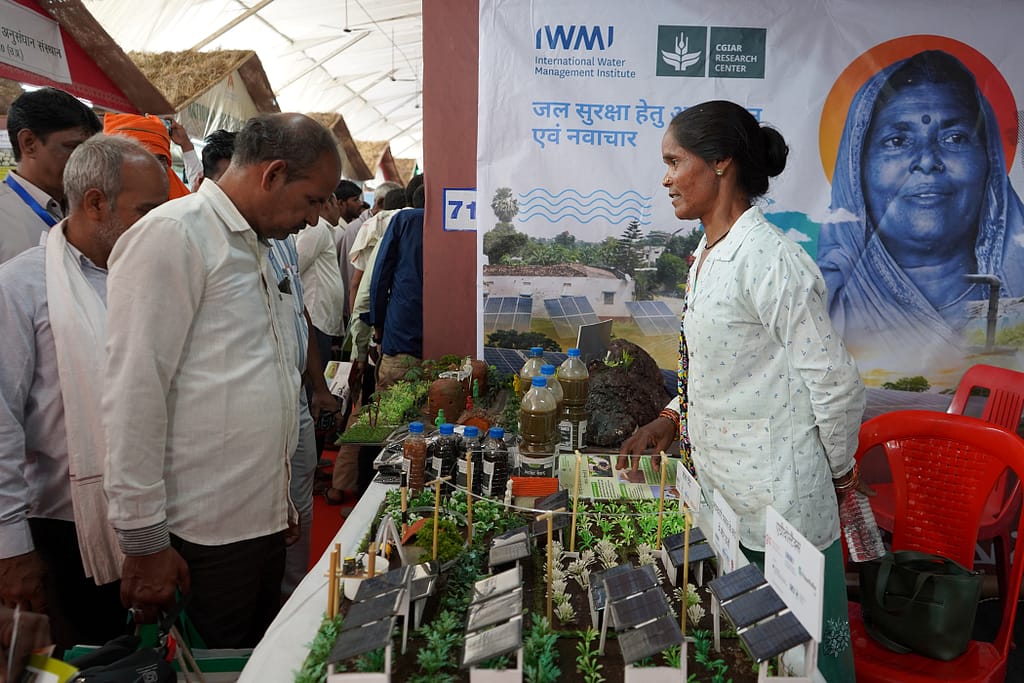
Under the intense summer sun at the Dussehra Ground in Raisen, India, 45-year-old farmer Savni Kulaste stands confidently at an exhibition stall. She explains farming models to a steady stream of visitors at the Unnat Krishi Mahotsav (Advanced Agriculture Fair), a national-level agricultural fair in India, focused on modern technologies, sustainable practices and enhancing farmer incomes.
What makes this moment remarkable is not just her role but her journey.
Kulaste has travelled nearly 300 kilometers from her village, Garhar in the Mandla district, to be here. Alongside her are three other women farmers — Sevkali Warkade from Kunda village, Sukhmania Marko from Lohar village, and Urmila Bhavedi from Pailibahu village also from Mandla district of Madhya Pradesh state. Together, they represent a growing network of women farmers practicing agroecological homestead farming over the past three years through initiatives supported by the International Water Management Institute (IWMI) under the CGIAR Multifunctional Landscapes program, in partnership with Professional Assistance for Development Action (PRADAN).
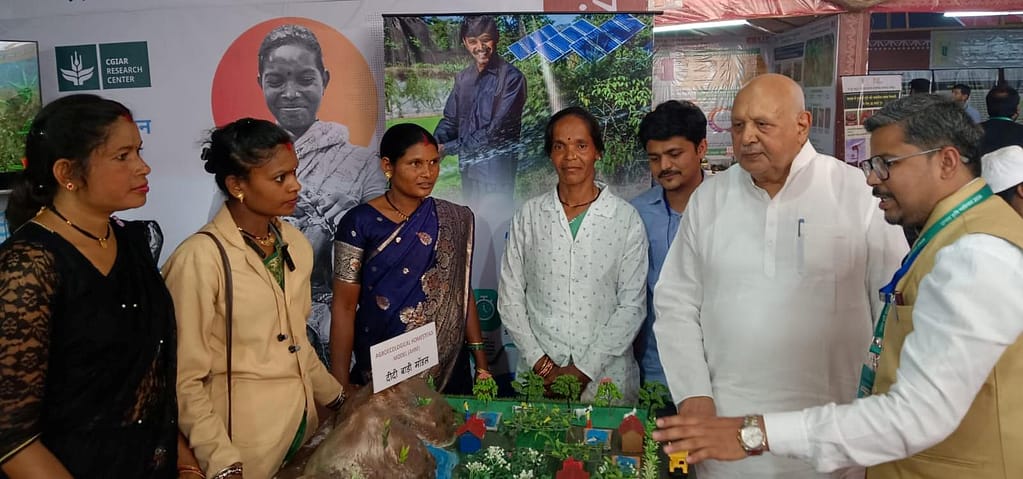
Standing beside the model Kulaste confidently explains to visitors how farming has transformed her life. “Earlier, from this small 400 square metre patch of land, we earned around $320 (30,000 India rupees) in a year. Now, our income has increased to $1280 (1.20 lakh Indian rupees) from the same land.”
She gestures towards the homestead model displayed at the stall, describing how diversification has made the difference. “We grow vegetables in multi-layers using a water storage setup that combines composting and bioformulations in the same space. It has improved both our income and our family’s nutrition.”
Throughout the day, Kulaste and her colleagues engage directly with visiting farmers, explaining how smallholder households can make better use of limited land through integrated, agroecological practices. “We are telling farmers that even with a small backyard, they can increase their income and nutrition if they plan farming properly.”
Bridging integrated solutions to farmers
Building on this strong community-led engagement, IWMI’s participation at the fair combined an interactive exhibition stall with a live field demonstration, operational across four days.
Visitors were able to explore three core models. The agroecological homestead cluster model demonstrated diversified and resource-efficient farming systems tailored for smallholders.
The low-cost biochar production unit showcased how invasive biomass like lantana that grows on grazing land can be converted into biochar to improve soil health, thereby freeing grazing land for livestock.
The solarization of agriculture model, which emerged as the central attraction, highlighted how renewable energy can be integrated into farming systems. The solarization model presented three scalable approaches. The Solar Didi model illustrated women-led irrigation enterprises providing water services to farmers. The solar cooperative model demonstrated how farmer collectives can generate and sell surplus solar energy while conserving groundwater. The Agrivoltaics model showcased the integration of solar panels with crop cultivation on the same land, enabling dual use of resources.
To support outreach and ensure accessibility, IWMI also distributed Hindi-language knowledge products, helping farmers better understand and engage with these technologies.
Demonstrating solutions for scaling climate-resilient agriculture
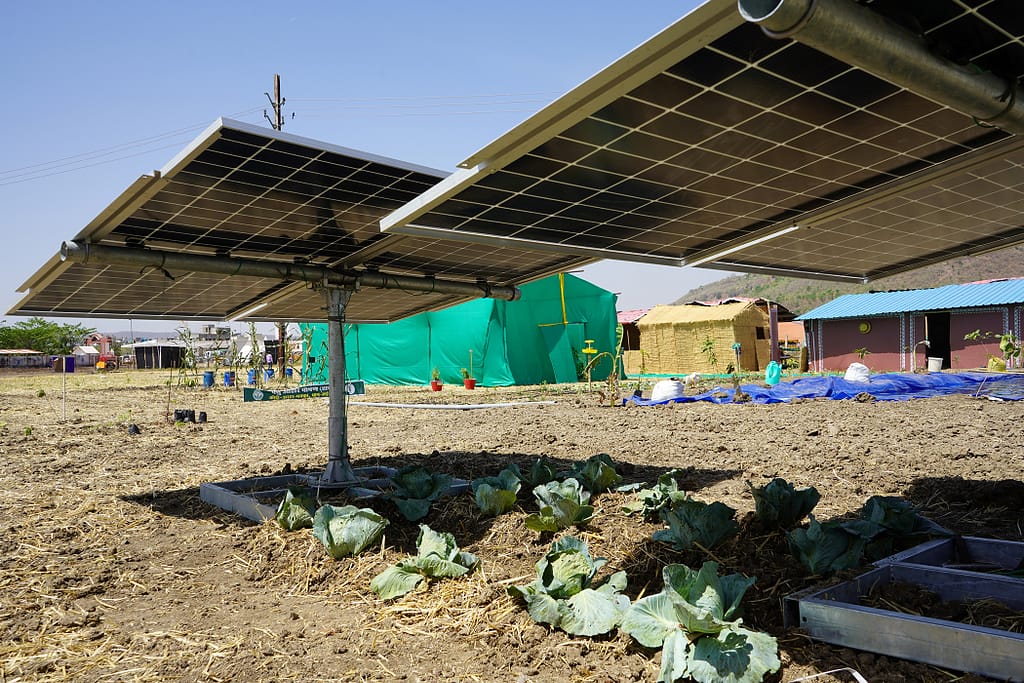
Complementing the exhibition stall, IWMI recreated a solar irrigation pump integrated with agrivoltaics and a solar-based drip irrigation system. The system featured a three-horsepower solar pump with six photovoltaic panels (approximately 530 W each), designed for water lifting and recirculation. Beneath elevated solar panels, vegetable crops were cultivated, demonstrating how land can be used simultaneously for food production and energy generation. Adjacent plots showcased solar-powered drip irrigation, highlighting efficient water use in crop production.
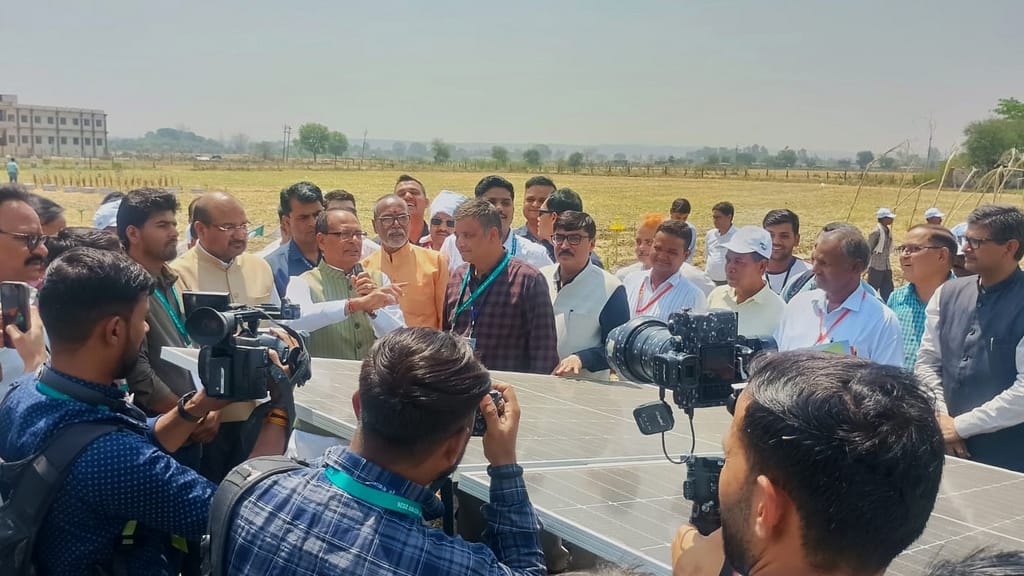
During his visit to IWMI’s demonstration site, Shivraj Singh Chouhan, Union Cabinet Minister of Agriculture & Farmers Welfare and Rural Development in India, highlighted the potential of integrated solar-based farming systems to enhance farmer incomes. “Farmers can grow vegetables under solar panels while using the same sunlight to run irrigation pumps — reducing dependence on electricity and diesel. With such integrated approaches, even small landholdings can significantly increase farmers’ income.”
This demonstration was part of the integrated farming system model developed by the Indian Council of Agriculture Research’s – Institute of Farming Systems Research. IWMI powered the one-acre farming model with solar-powered irrigation pumps and drip systems.
Farmers who visited the stall showed particularly strong interest in solar irrigation technologies, government subsidy schemes, cost-benefit aspects and application procedures.
“In our area, there are nearly 300 borewells. Whenever electricity is available, all the pumps run at the same time, and the water level drops quickly. Even at depths of 350–400 feet, we often don’t get enough water for irrigation. I am now exploring solar irrigation so that I can avoid this electricity crisis and have more reliable access to water for my farm,” said Manohar Gowda, a farmer from Raichur district, Karnataka state. There was also considerable curiosity around agrivoltaics and its practical feasibility.
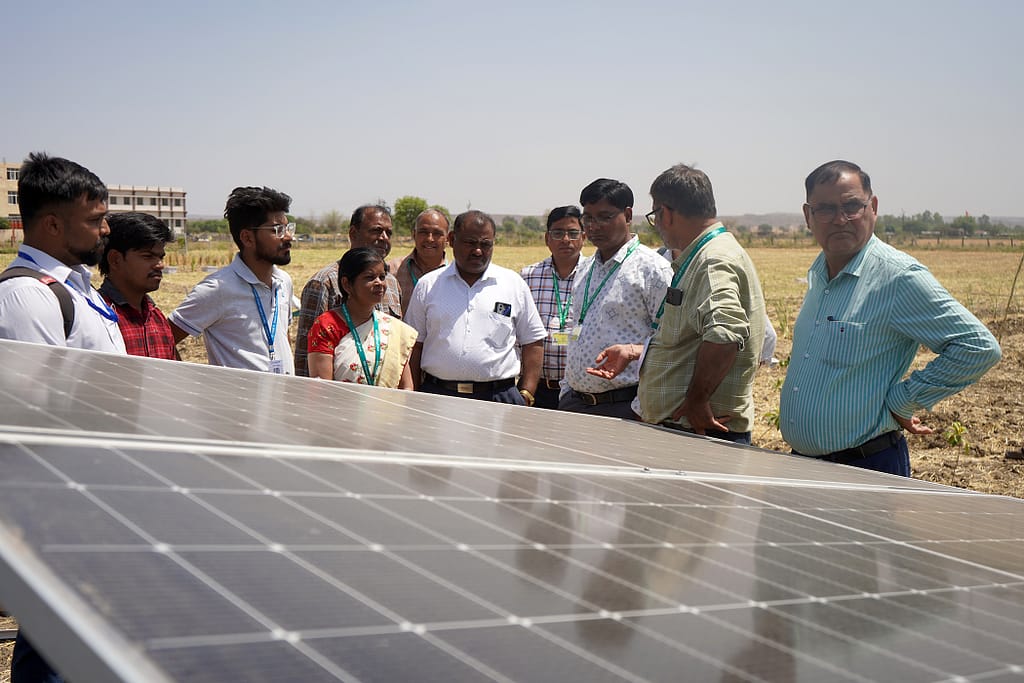
The fair provided an important platform for engagement with senior policymakers and researchers from national and state institutions, including ICAR, Ministry of Agriculture & Farmers Welfare and the Department of Land Resources, Ministry of Rural Development. Through these interactions, IWMI contributed to technical discussions focusing on agrivoltaics and watershed management under changing climate conditions. These exchanges facilitated knowledge sharing on how innovative solutions can be integrated into ongoing rural development programmes.
“India’s climate resilience journey will depend on how effectively we integrate water, energy, and agriculture solutions at scale. Platforms like this help bridge research, policy and practice,” said Gopal Kumar, IWMI’s interim country representative for India and Bangladesh.