

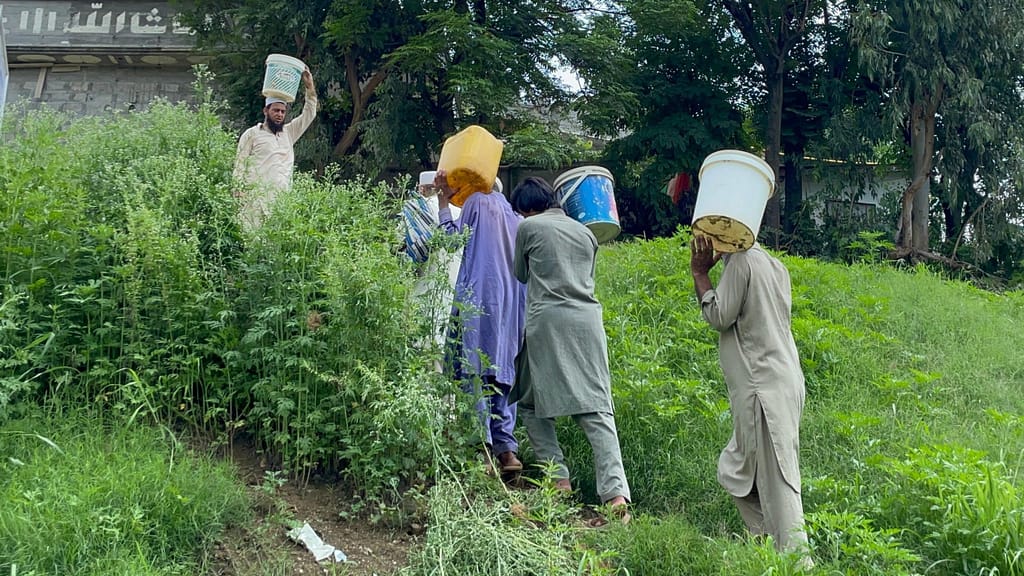
“We spent hours climbing steep slopes just to bring a few cans of water. It was heavy on our backs and dangerous under our feet. Every step felt like a risk, especially for our children,” says Rehmat Bibi, a resident of Mansehra, in northern Pakistan, where water has always been a daily struggle. For generations, families have risked their safety climbing down slippery slopes to fetch water from fast-flowing streams. “Sometimes it felt like our whole lives were lost on that path,” shares Bibi, explaining that every drop cost time and energy.
Water from the public supply ran only for a few hours each day, and the village taps could not fulfil daily needs. The Siran River below the villages was a risky lifeline. Women washed clothes in dangerous currents and children slipped on rocks. Elderly men and women, despite their frailty, often joined in the effort, as survival demanded every hand. Families lost hours each day to this chore.
Nearly 80% of Mansehra’s farmland depends entirely on rainfall, which is increasingly erratic as the climate changes. When the rain does not come, families struggle to protect their crops and secure water for basic household needs. Some households turned to diesel or electric pumps, but the cost of fuel and electricity was crippling. For families already living on the edge, paying for water often meant sacrificing food, healthcare or education. Government schemes offered partial relief, but water rarely reached every household. In many villages, there was just enough to survive, but never enough to live with dignity.
In the Siran River, families bathed, washed clothes, nourished their animals and collected drinking water from the same stream, exposing themselves to health hazards.
“Our house is on a hill,” says Akbar Jan, a father of six and small-scale farmer. “It would take ten minutes to climb down and another five to reach the river. Then half an hour just to bring home one gallon of water. Imagine doing that several times a day, every day.”
Simple technology, transformational change
That reality began to change with the introduction of eight hydraulic ram pumps, installed by the International Water Management Institute (IWMI) across four sites — Aznali Ichrian, Tarkanal Ichrian, Dharyal Sarye and Sum Valley.
The systems lift water as high as 150 to 200 feet without electricity, diesel, petrol or solar power. Using only the natural slope of the land and the force of flowing water, the pump operates continuously, all day and year-round. Collectively, the eight pumps are already reaching about 400 households and 2,340 residents.
One of the most significant achievements of this intervention is its zero-operating cost. Water is lifted uphill entirely through a simple mechanical process, requiring no external energy input. Flowing stream water is diverted into a pipe, which carries water downhill to the hydraulic ram pump, typically over a vertical drop of 15 to 25 feet that builds momentum.
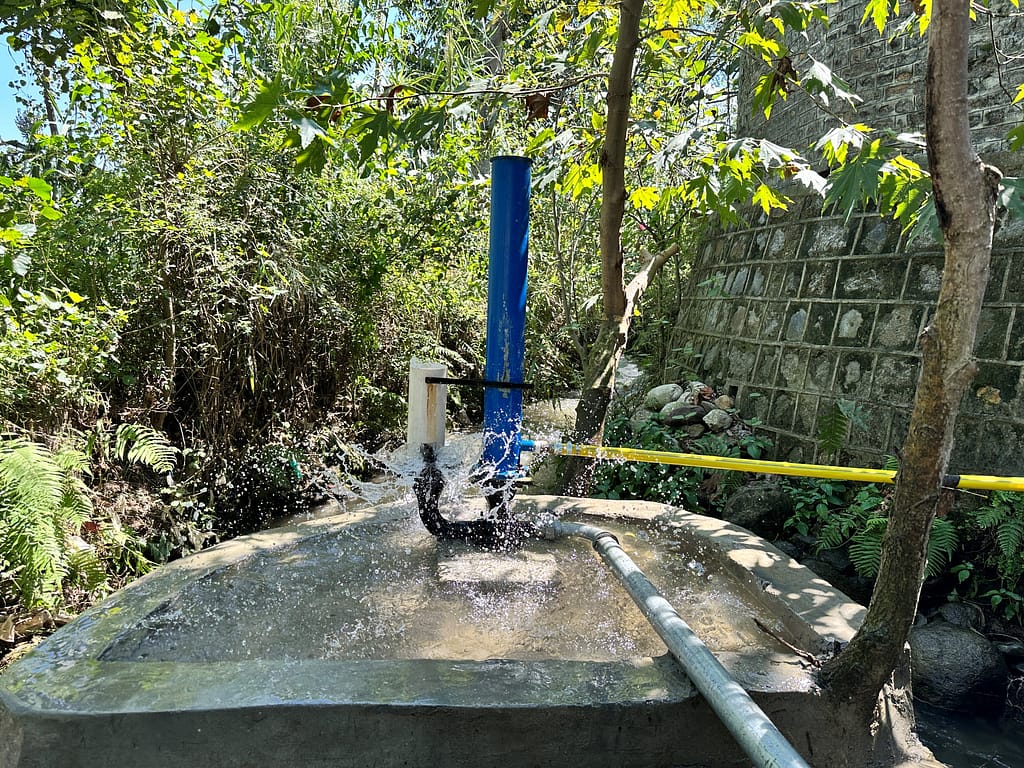
Inside the pump, a valve mechanism suddenly closes, creating a phenomenon known as the water hammer effect — a pressure surge caused by the abrupt stop of moving water.
This pressure surge is the core of the system. It compresses a small volume of water inside an air chamber within the pump, generating enough force to push a portion of the water uphill. After this pressure builds, a delivery valve opens and forces water into a smaller pipe, increasing the pressure and helping propel water upward.
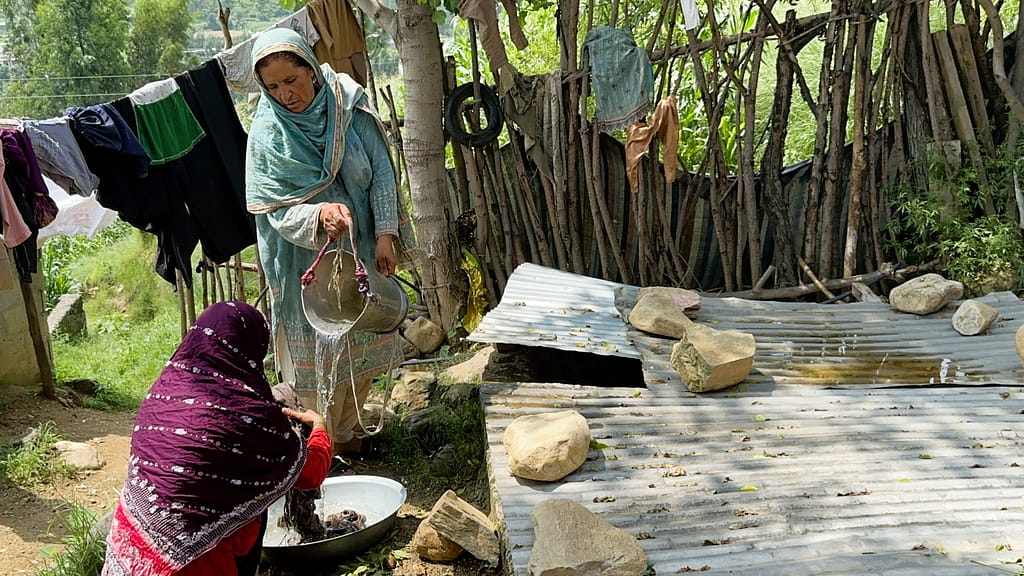
Once pumped, the water is stored in elevated tanks near the settlements. From these tanks, water is distributed through a network of pipes to households for non-potable uses, including washing, cleaning, livestock watering and sanitation.
Over 50 acres of land revived to support livelihoods
Beyond meeting household needs, the reliable availability of water has directly translated into expanded agricultural activity. Approximately 51.5 acres of land are now used for agriculture that was previously rainfed or left uncultivated due to water scarcity.
Of this area, around 10 acres are used for kitchen gardening. In these small plots, often located on terrace-like fields close to homes, families grow seasonal vegetables such as tomatoes, potatoes, spinach, eggplant and ridge gourd. The surplus produce is sold locally to supplement household incomes.
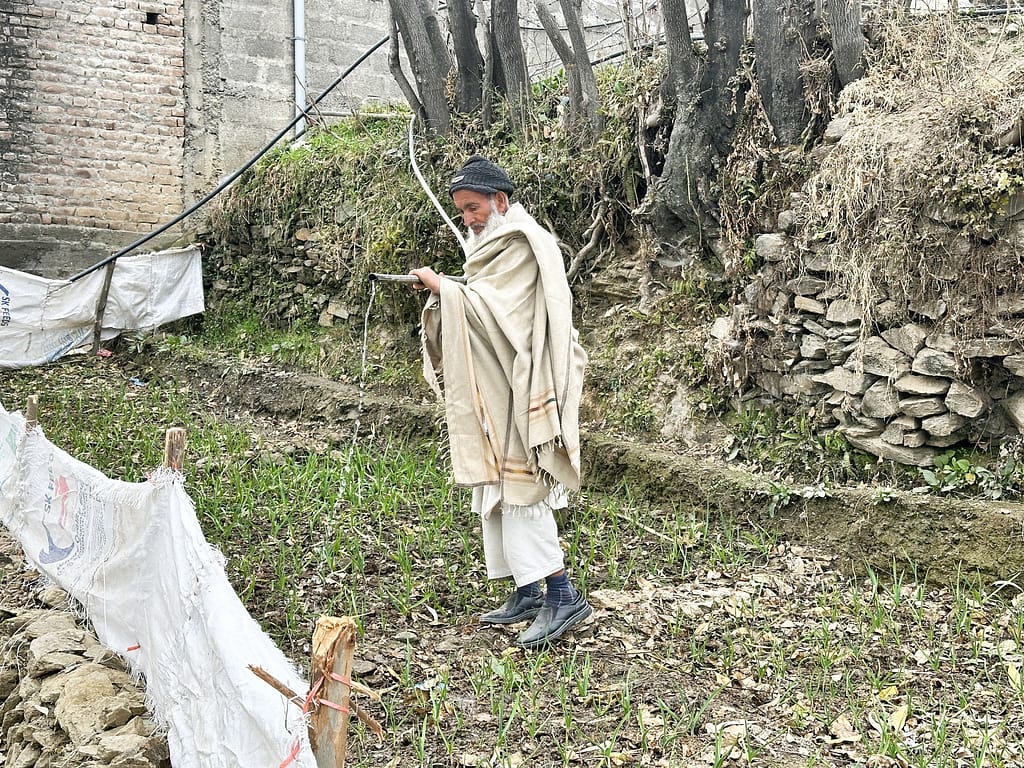
Currently, an estimated 50 households, including 20 women farmers, are engaged in kitchen gardening using water supplied through the hydraulic ram pump system. This has significantly improved household nutrition, reduced food expenses and strengthened food security.
For many women, this marks their first opportunity to actively participate in agricultural production beyond subsistence roles. With water available near their homes, women can manage kitchen gardens alongside domestic responsibilities, giving them greater control over food choices and household wellbeing.
IWMI has also installed soil moisture sensors to enhance the efficient use of available water by tracking when irrigation is needed. This judicious, water-saving approach to irrigation, under climate-smart water conservation practices, was specifically adopted to ensure that every drop counts.
Irrigation using gravity, with no pumping costs
An equally innovative aspect of the system is the productive use of surplus water. Because the hydraulic ram pump runs 24 hours a day, storage tanks often fill to capacity. Instead of allowing excess water to overflow and go to waste, the system channels it back downhill through gravity-fed pipelines.
This water is then used for sprinkler and drip irrigation systems installed on terraced and sloped fields below. Through this approach, an additional six acres of land are being irrigated using gravity alone, without any pumping or energy costs.
Each pump replaces the need for diesel or electricity-operated pumps, saving more than seven tons of carbon dioxide emissions annually. With no fuel costs, no electricity bills and minimal maintenance requirements, the system offers a climate-smart and financially sustainable alternative for mountainous communities. The entire cycle operates through natural forces, making it a true nature-based solution that combines efficiency, sustainability, and environmental protection.
Less time collecting water labor means more time for life
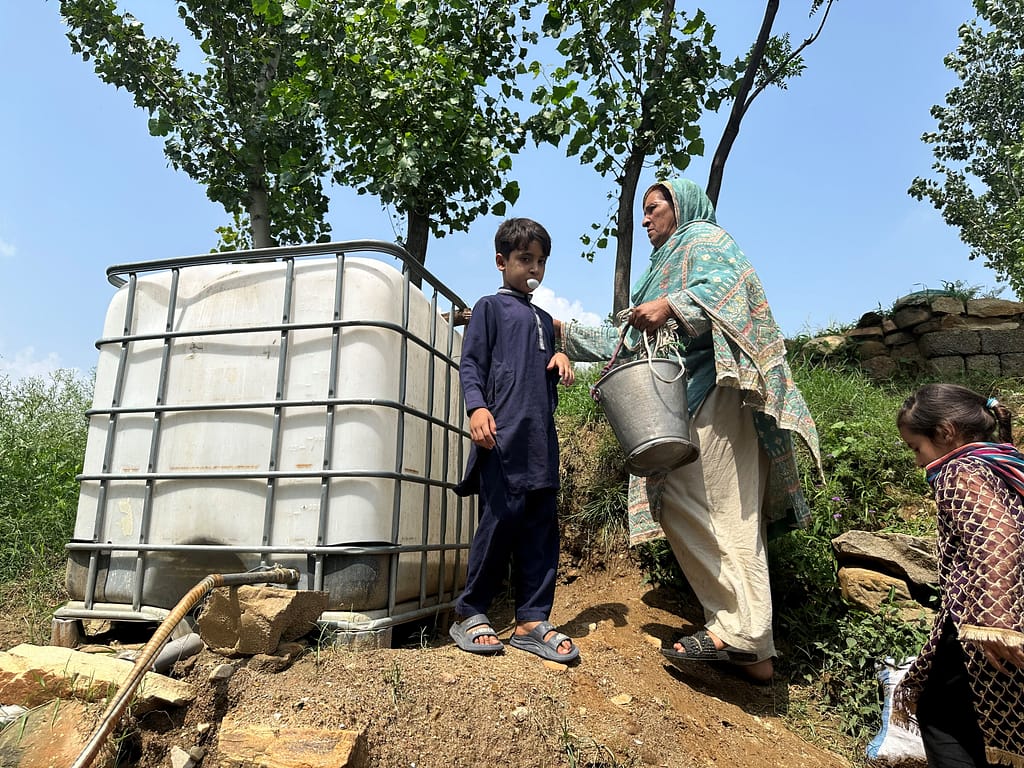
For Iqra, a 20-year-old resident, the change is deeply personal. She remembers the hardship of fetching water during Ramadan — the holy month of fasting in Islam, during which Muslims fast from dawn until dusk. “Even while fasting, we had to climb down and up the hill. For pregnant women, it was unbearable. We lost so much time and energy just fetching water,” she says.
Today, water is available close to her home. “Now we have enough water for washing, cooking, cleaning and our animals. The time we save is used in taking care of our children, going to school and working in the fields. Our lives feel better and lighter.”
Women no longer risk their safety on slippery slopes. Children, once burdened with carrying heavy containers, now attend school more regularly. The elderly enjoy the comfort and safety of having water within reach.
The intervention has also brought major improvements in livestock health and productivity. Families no longer need to take their buffaloes, cows and goats down steep terrain to rivers and streams for drinking water.
These animals had previously dissipated considerable energy when repeatedly climbing down and uphill, leading to fat loss, reduced milk production and body weight, poor reproduction and higher risks of illness and mortality. As livestock are sold based on net weight, this directly affects household income. With water available near homes, livestock health and milk production have increased.
Sustainable climate resilience through nature-based solutions
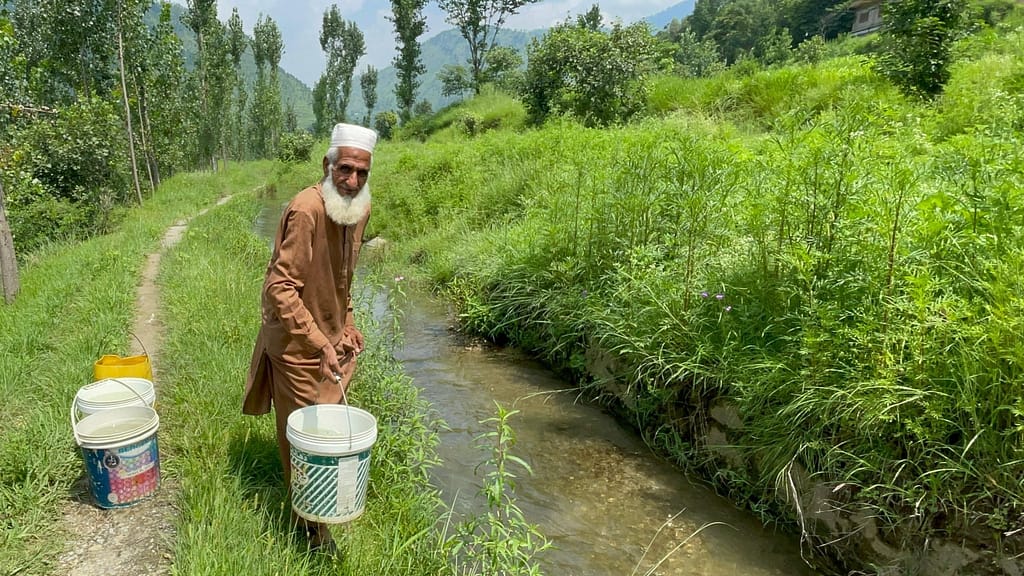
Mansehra is identified by the Pakistani government as a climate-vulnerable hotspot, due to steep terrain, rain-dependent agriculture and frequent climate hazards. By reducing reliance on erratic rainfall and fossil fuels, the hydraulic ram pump system enables communities to adapt to climate change. At each site, 10 people have been trained in basic operation and maintenance, strengthening community ownership and long-term sustainability.
The hydraulic ram pump is an example of resilience technology. Some households are combining pump-supplied water with basic rainwater harvesting techniques, including rooftop collection systems and small runoff storage structures, to further strengthen their water security. With water available at their doorsteps, these communities can now think beyond subsistence. However, challenges remain. While water is now available for domestic, agricultural and livestock use, access to safe drinking water is still a need. “The pumps have given us relief,” says Iqra. “But our hope now is for safe drinking water. If we can achieve this, our lives will be complete.”


