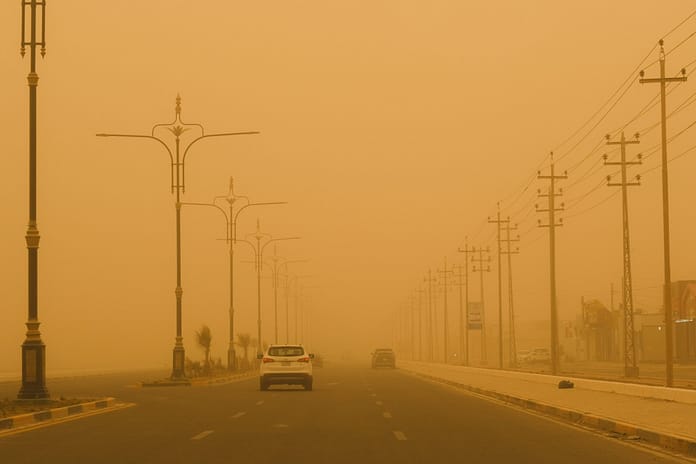
By the shared borders of Botswana, Mozambique, South Africa and Zimbabwe rests the Limpopo River Basin, a transboundary waterway. For the communities that surround it, water scarcity, pollution and climate stress are daily realities. Youth in remote communities, smallholder farmers and local river monitors are on the front lines of these daily stressors, and increasingly, digital tools are being deployed to help them respond.
But are these tools built for the people who need them the most?
The International Water Management Institute (IWMI) set out to answer this question by measuring the equitability of three development-focused digital tools currently in use in the Limpopo River Basin: miniSASS (Mini Stream Assessment Scoring System), the Limpopo Digital Twin and Yoma (Youth Agency Marketplace).
An index to measure equity

The Multidimensional Digital Inclusiveness Index (MDII) is an evaluation framework developed to assess whether digital tools work equitably. It asks: Who can access this tool? Who benefits? Who is left out and why?
MDII evaluates how useful digital tools are in terms of their social consequences, innovation usage and stakeholder relationships. The dimension of social consequences examines how a digital tool creates value and manages harm. Innovation usage considers how usable and accessible it actually is, while stakeholder relationships looks at how ethical, transparent and collaborative the design process of a digital tool is. MDII further breaks down its three-tiered evaluation to seven dimensions ranging from accessibility, usage effectiveness, supportive ecosystems, beneficial impact, risks and harms, ethical and responsible innovation, to co-creation and governance.
The MDII assessment does something that is still relatively rare in development-focused digital projects. It treats inclusiveness not as a soft add-on but as a measurable, trackable dimension of tool quality. It asks hard questions about governance and power, not just about features and functionality.
MDII scores show all tools have scientific and social value, yet there is room for improvement
So what did we find? Simply put, the tools are working and communities value them. The science behind them is sound and the people using them want to keep using them. But there is room for improvement.
In several areas, the experience of using these tools day-to-day does not yet match the ambition behind them. The interfaces can be difficult to navigate, data costs are pricing out some communities and the formal structures needed to ensure communities have a say in tool’s evolution are still being built.
The fact that all three tools meet the minimum inclusiveness threshold means the project has a real foundation to build on. The scientific and social value is already there, along with community trust. What is needed is deliberate design investment in the dimensions where these tools fall short. Which includes usability for non-specialists, ethical governance architecture and accessible physical and technical infrastructure.

miniSASS has exceptional community engagement but usability can be improved
With an overall MDII score of 64%, miniSASS is the strongest performer in the triad. Also known asthe Mini Stream Assessment Scoring System it is a citizen biomonitoring tool that enables non-specialists, including schoolchildren, to assess river health by identifying aquatic macroinvertebrates. It is free, physically simple and rooted in established science.
miniSASS community engagement culture is exceptional, scoring 95%, but has a glaring contradiction. Field practitioners perceive the tool as highly valuable and relevant, indicating strong perceived value. However, this is constrained by a lower ease-of-use score. The digital interface presents an opportunity to be streamlined and made more intuitive, enabling smoother and more efficient user interactions. In essence, the methodology is strong, but the app, in its current form, has room to better align with the usability needs of the communities it is intended to serve.
The Digital Twin delivers on user needs but falls short on accessibility
The Digital Twin is the project’s most technically ambitious tool — an integrated hydrological model of the entire Limpopo River Basin — designed to give water managers near real-time insights for decision-making.
With an overall MDII score of 52% the Digital Twin shows strong alignment with real-world challenges, user needs and local context. However, accessibility remains limited. Simplifying interface interactions and improving clarity around cost-related aspects would help extend accessibility beyond technical specialists to regional officials, community leaders and extension agents. End users need information that is easier to interpret and act on.
Yoma engages youth effectively, though its ethical oversight is still evolving
Yoma, UNICEF’s Youth Agency Marketplace, serves as an incentive engine, rewarding youth for completing environmental monitoring tasks with blockchain-based digital credentials that can unlock employment and economic opportunities.
With an overall MDII score of 50%, Yoma shows a strong security architecture for preventing fraud and protecting data. The tools also scored favorably on youth engagement. At the same time, ethical and responsible innovation remains at early stages of maturity, particularly in relation to ethical oversight. This points to an opportunity to further strengthen governance structures, such as introducing independent review mechanisms and safeguards to monitor how reward pathways may impact different groups of youth.
Key recommendations for improving these digital tools based on their MDII scores
All three tools scored between 50% and 64% placing them in the “Approaching Expectations” tier. It would be easy to read this as a mixed result, but that would miss the point of a baseline assessment. These scores are not verdicts. They are starting points.
In this exercise to strengthen and guide the continued evolution of these tools, three priority areas emerged for improvement in the next iteration:
Make the tools work for everyone, not just specialists.
The next design phase should focus on meeting users where they are. Which means simplified interfaces with clear icons and plain-language guidance, offline functionality for areas with limited connectivity and low-bandwidth modes that reduce data costs. For the Digital Twin, this means creating visual summary outputs like infographics and role-specific dashboards so that regional officials and community leaders can act on the tool’s data without needing GIS expertise. For miniSASS and Yoma, it means redesigning onboarding flows so that a first-time user in rural Mozambique can engage confidently from day one.
Build the governance structures that communities deserve.
The project is committed to moving beyond institutional partnership into genuine co-governance. For all three tools, this means establishing multi-stakeholder advisory groups that include youth representatives, women’s groups and local river monitors in strategic decisions about how these tools evolve. For Yoma specifically, the next phase will formalize ethical oversight structures ensuring that the platform’s reward pathways are independently reviewed and that youth understand how their data contributes to basin-level decisions. Bias monitoring mechanisms should be introduced across all tools so that no community group is inadvertently excluded as the tools scale.
Close the infrastructure and affordability gap.
Mobile data costs, connectivity requirements and hardware barriers remain the most persistent obstacles to equitable participation. For the Digital Twin there are practical and quick solutions to overcome this: data bundle partnerships with regional organizations, offline syncing capabilities and cost-transparent guidance for the institutions considering adopting the tool. The goal is a suite of tools that work in real field conditions, not just those assumed by designers.
How do we make these digital tools more equitable?
The MDII assessment identifies concrete, actionable paths forward for each tool. For miniSASS: a simplified interface, offline syncing and low-bandwidth modes. For Yoma: an ethical oversight committee, bias monitoring mechanisms and localized impact missions that connect youth tasks directly to basin-specific challenges. For the Digital Twin: simplified visual outputs for downstream actors, role-specific dashboards and transparent cost guidance for regional institutions.
The recommendations from this assessment will feed directly into the next phase of development of the Limpopo Digital Twin. IWMI will work with LIMCOM and riparian-state partners to co-design localized features. Ethical oversight structures will be formalized. Interface redesigns will be guided by the specific usability failures identified among field practitioners.
The Limpopo River Basin’s water security challenges are urgent. The youth who live and work in that basin deserve digital tools that meet them where they are not where their designers imagined them to be.
That is what inclusive digital design means in practice. And that is what this assessment was built to measure.