


Perhaps no other region in the world faces such a stark combination of enormous potential and profound challenges as South Asia does. Its rapid economic growth, swift urbanization and growing populations are met head-on with acute environmental concerns and resource constraints.
Although South Asia is home to a quarter of the world’s population, it holds less than 5% of global freshwater resources. The water supply-demand gap is considerable; South Asian economies are highly reliant on hydropower, while their agricultural systems account for a third of all global groundwater pumping. The interconnectedness of water, energy and food security is especially pronounced in the region, where many critical river basins flow across national borders and climate vulnerability is acute.
A systems or nexus approach, which considers the interconnections between water, energy, food and environmental (WEFE) systems, has great potential, but can become paralyzing for decision-makers if not supported with capacity building and a clear operational plan. Historically, progress on creating secure WEFE systems has been hampered by a siloed focus. As a result, policies designed to solve one problem have inadvertently created another. For example, in Pakistan, as estimated 12 billion cubic meters of water are not optimally used, flowing to thirsty crops like rice and sugarcane, which generate relatively low economic returns for the high volume of water they consume.
So, how do we move from the theory of a nexus systems approach to its practical application? Outputs from the Water-Energy-Food-Environment (WEFE) Nexus Policy work of the CGIAR Policy Innovations Program provided a strategic regional roadmap to make a systems-based nexus approach an operational reality in South Asia.
A WEFE roadmap for a complex region
The starting point is a clear-eyed view of the on-the-ground challenges. Interestingly, the primary barriers to progress are often institutional rather than technical. Through extensive stakeholder consultations, the International Water Management Institute (IWMI) identified six key challenges to operationalizing a nexus approach in South Asia. These include fragmented governance and institutional silos, competing priorities and policy trade-offs, data and information gaps, financial constraints, limited private sector engagement, and inefficient regional cooperation and transboundary challenges.
To overcome these challenges, experts from IWMI and the Asia Disaster Preparedness Centre (ADPC) proposed a strategic roadmap for the region, focusing on actions such as promoting cross-sectoral collaboration, strengthening data collection and enhancing international cooperation for shared water resources. While these directives apply to the whole region, experts emphasize that implementation must be context specific. For instance, sustainable hydropower and watershed conservation are priorities for upstream nations like Bhutan and Nepal. In contrast, for India and Pakistan, the priority shifts to managing the energy-groundwater nexus to prevent aquifer depletion. Meanwhile, for Bangladesh and Sri Lanka, the focus is heavily tilted toward climate resilience, managing salinity intrusion, and pollution control in deltaic and coastal systems.
Practical tools to measure success
A high-level roadmap, however, requires practical tools to guide specific decisions and measure progress. This is where decision support systems (DSS), including those developed by IWMI research teams, come into play. These analytics platforms provide policymakers with information dashboards on the competing demands on agriculture and water resources and the overall impact of policy decisions on the WEFE nexus.
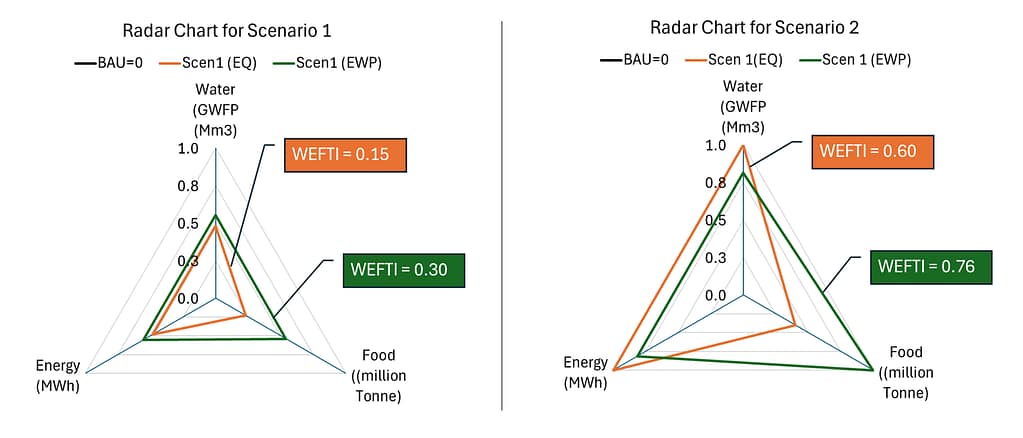
A key feature of IWMI’s newly-developed Water-Energy-Food (WEF)-Nexus DSS is the ability to generate the WEF Nexus Index; a composite scorecard that measures the combined health of interconnected systems. This involves combining availability and productivity indicators for the trio of water, energy and food into a single, normalized score: the WEF Trade-off Index (WEFTI). Crucially, it allows policymakers to quickly see if a chosen policy is a net positive or negative for the system as a whole.
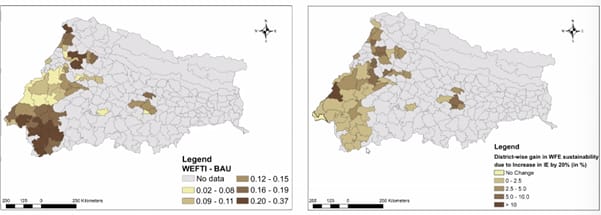
Other complementary tools like the Water Productivity Atlas models specific scenarios at the district and basin level. For example, a scenario presented for Haryana district in India, modelled a shift away from thirsty crops like rice and sugarcane, towards more diverse and nutritious crops like millets and vegetables. The Water Productivity Atlas showed clear, measurable gains. The groundwater footprint was reduced, total energy consumption fell by 13% and economic water productivity nearly doubled. The WEF-Nexus DSS then synthesized this data, and the resulting visual ‘radar charts’ showed a dramatic improvement in the overall WEFTI score, providing a clear, evidence-based case for this crop diversification strategy.
Turning tools into tangible impact
These tools and roadmaps are crucial, but making them work in the real world requires a focus on implementation. The adoption of new, integrated approaches is often driven by policymakers feeling a ‘pain point,’ such as dwindling financial resources, which pushes them to seek more efficient solutions.
For the way forward, several key considerations emerge. First is the need to document and share ‘stories of success’ to prove the value of these tools and build momentum for their adoption. Second, in the complex political reality of South Asia, creating smart incentives for stakeholders is often more effective than top-down legislation. Finally, success requires institutional champions and collaborative structures, like inter-ministerial committees, to break down silos.
By combining a strategic regional roadmap with practical analytical tools and a clear focus on real-world implementation, the aspiration of a systems approach can be turned into a confident reality.
Alok Sikka was the country representative for India and Bangladesh at IWMI, Bunyod Holmatov is the research group leader for WEFE Nexus at IWMI, Claudia Ringler is the co-lead for WEFE Nexus Policy at CGIAR Policy Innovations Program, and director of Natural Resources and Resilience at the International Food Policy Research Institute (IFPRI), and Mohsin Hafeez is the WEFE Nexus Policy lead and strategic program director for Water, Food and Ecosystems at IWMI.


