At the 19th World Water Congress in Marrakech held from December 1-5, co-organized by the International Water Resources Association and Morocco’s Ministry of Equipment and Water, a clear message emerged: innovation is no longer the main constrain. The real challenge now lies in connecting solutions across systems — water, food, energy, ecosystems, communities, finance and governance — and scaling them for long-term impact.
“Marrakech marked a shift away from searching for the next breakthrough,” said Youssef Brouziyne, regional representative for MENA at the International Water Management Institute (IWMI). “The conversation has moved toward how we bring existing solutions together — across sectors, institutions and communities to reach lasting water security.”
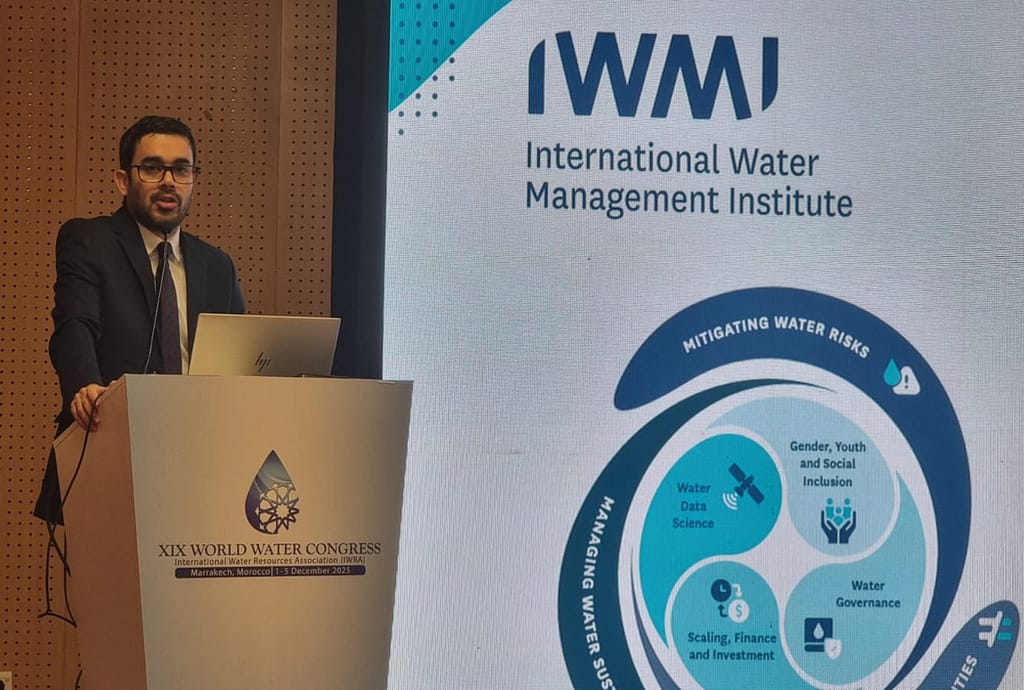
IWMI teams from Egypt, Ghana, Laos, Nepal, Pakistan and Sri Lanka brought this systems lens to Marrakech, contributing insights on wastewater reuse, groundwater resilience, gender-responsive governance, integrated crop-aquaculture, AI and digital irrigation tools across a range of 12 sessions, poster presentations and countless technical exchanges.
Making water, energy, food and ecosystems work for everyone
In Marrakech, Sanju Koirala, social scientist at IWMI, brought two perspectives that resonated strongly with participants. First, she shared how IWMI Nepal — under the project Transboundary Rivers of South Asia (TROSA) — is introducing a framework that places women, historically marginalized caste groups in South Asia like Dalits and other excluded communities at the center of decision-making.
IWMI’s approach to linking water, energy, food and ecosystems with gender and inclusion at its core was new to many Congress attendees. The team’s multi-step, hands-on capacity-building process stood out as a practical way for local governments to move beyond siloed planning. “Gender-responsive, cross-sector capacity building is no longer a ‘nice-to-have’ — it’s becoming essential for inclusive resource management and equitable water security,” Koirala pointed out.
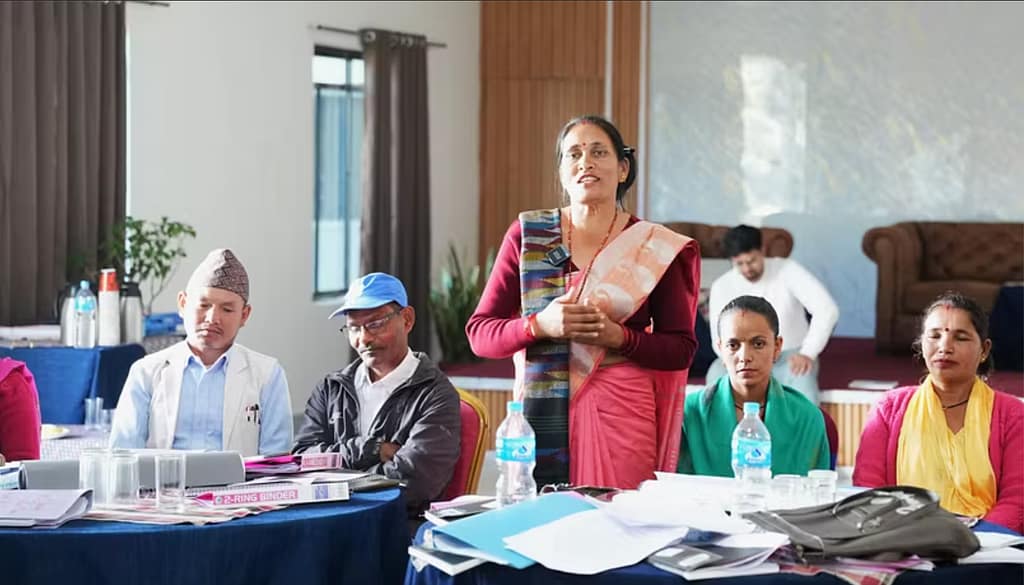
She also reflected on IWMI’s work in Cambodia, India and Nepal, noting that innovations only take root when they are co-created with governments and communities, supported by evidence and reinforced through clear incentives and strong coordination. “I left Marrakech with the sense that systems thinking is slowly but firmly gaining ground across the Global South,” she said.
Integrated food systems approach brings resource management, productivity and livelihoods together
Researcher Pacem Kotchofa, who works on the political economy of food, land and water policies at IWMI, brought a food-systems lens to the Congress, demonstrating how integrated crop–aquaculture farming in Myanmar is helping smallholder households become more resilient in the face of climate and water stress.
Her analysis, conducted under the CGIAR Sustainable Animal and Aquatic Foods (SAAF) program in Southeast Asia, draws on nationally representative household data and climate–aquaculture mapping tools. She found that farmers who grow crops (in this case, rice) alongside fish are less likely to experience food insecurity, as these integrated systems provide year-round food production, diversify income and use water and agricultural land more efficiently, especially in water-scarce regions.
“Whether these systems succeed depends less on farmers’ wealth alone than on the conditions around them,” she said, pointing to the role of key infrastructures and the aquaculture expansion value chains, including hatcheries, nurseries, local markets, extension services and policies that support integrated farming as part of the land-water-food nexus strategies.
Discussions in Marrakech reinforced a growing consensus: integrated, cross-sectoral approaches are essential to move beyond siloed resource management that often leads to inefficiencies and policy gaps. “This work is relevant well beyond Southeast Asia, especially to water-scarce regions like MENA, where the principle of “each drop counts” has become a harsh reality,” noted Kotchofa.
Data, AI and the enabling environment for scaling
If integrated approaches define the “what” of water resilience, digital tools and artificial intelligence (AI) are increasingly shaping the “how.” In Marrakech, this shift was especially visible in discussions around water quality monitoring where data gaps remain one of the biggest barriers to action.
Senior IWMI researcher in hydrology and water resources management Seifu Tilahun, shared how his team, in collaboration with Bahir Dar University, uses satellite data and machine learning to estimate key water-quality indicators such as chlorophyll-a, total nitrogen and total phosphorus in African lakes where field monitoring is limited.
After testing several algorithms on Ethiopia’s Lake Tana and successfully adapting the strongest models to Kenya’s Lake Naivasha, the work shows how AI and remote sensing can deliver reliable, scalable insights across data-scarce regions.

“The response to our work made it clear that AI and remote sensing are no longer optional for countries facing both water scarcity and data gaps,” Tilahun said. What resonated most in Marrakech, he added, was the recognition that machine learning can turn limited observations into actionable intelligence, particularly for countries with the double burden of water and data scarcity.
But the conversations in Marrakech also made clear that better data is only the starting point. That insight carried into IWMI’s special session on Scaling Water Solutions in a Water-Scarce World under the CGIAR program on Scaling for Impact, where discussions — from solar-based irrigation and gender-responsive governance to grid-connected solar pumps systems and micro-irrigation practices — underscored a shared lesson: innovation is abundant, but impact only follows when technology is bundled with enabling policies, access to finance, institutional coordination mechanisms and cross-sector partnerships that allow successful pilots to scale.
Morocco itself emerged as a live case study in system-wide water management under pressure. After seven consecutive years of drought, the country is accelerating a transition that combines large-scale investments in desalination, wastewater reuse, groundwater recharge and inter-basin transfers through collaboration with local communities and startups to identify solutions for water efficiency.
At the Congress’ opening, Moroccan Minister of Equipment and Water Nizar Baraka indicated that Morocco is moving toward a water-energy-food nexus model, linking these sectors through a unified policy and shared vision aimed at delivering tangible benefits for Moroccan citizens.
From Marrakech to the UN 2026 Water Conference
The Congress closed with the adoption of the Marrakech Declaration, a collective call to elevate water as a global priority and to accelerate investment in climate-resilient infrastructure, wastewater reuse, cooperation and governance approaches that connect water with food, energy, health and ecosystems.
At its core, the Declaration signals a shift away from fragmented responses toward integrated action and from short-term fixes toward long-term resilience.
“The Marrakech Declaration makes the stakes clear: water must be treated as a global priority at COP31, the 2026 UN Water Conference and beyond. Resilience depends on recognizing water as the backbone of climate, economic and social stability,” concluded Brouziyne.