

In Southern Africa, climate change is not a future threat; it is a present-day reality. Historic droughts, rising temperatures and increasingly erratic rainfall are putting immense pressure on the region’s water resources, threatening the livelihoods and food security of millions. In this context, water storage is not a luxury; it is the frontline of climate adaptation.
For decades, the default solution to water storage was large-scale “grey” infrastructure. But while large dams remain critical, they are costly, have significant environmental impacts and are often too centralized to serve remote, rural communities. The climate crisis, with its unpredictable shocks, has exposed the vulnerability of relying on any single solution.
This new reality demands a new, more integrated approach — something that has been highlighted through stakeholder workshops in Zimbabwe and Botswana held under the CGIAR Initiative on NEXUS Gains. It is clear that the future of water security lies in a diverse portfolio of options, including large reservoirs, managed aquifers, soil moisture storage and smaller-scale, decentralized nature-based solutions.
Among the most promising of these are sand dams, a climate adaptation tool that is hiding in plain sight.
What is a sand dam?
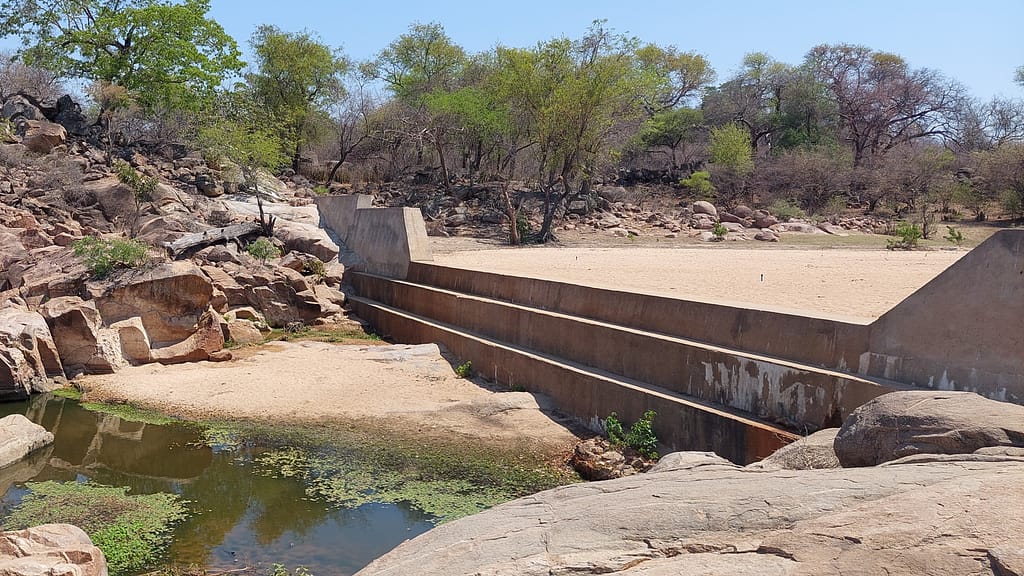
A sand dam is an elegant, low-cost solution. It is a low, reinforced concrete wall built across a seasonal, sandy riverbed. During the rainy season, as water flows down the river, the dam wall slows the flow, causing sand to accumulate behind it. Over a few seasons, this creates a new, larger, man-made aquifer.
The water is not stored in an open reservoir; it is stored in the sand itself. This simple design is a powerful climate adaptation strategy for two key reasons. First, it protects water from evaporation. By holding water beneath the surface, it is shielded from the hot, arid climate — a critical advantage over surface dams. And second, it filters the water. The sand acts as a natural filter, cleaning the water as it is stored.
This stored water can then be accessed during the dry season via shallow wells or hand pumps, providing a reliable source for domestic use, livestock and small-scale farming. While sand dams have been used for years, a lack of rigorous, comparative data has held them back from widespread policy adoption.
To fill this evidence gap, a multi-year research collaboration studied 20 sand dams across 19 communities in Zimbabwe’s Shashe catchment. This effort involved the International Water Management Institute (IWMI), the Dabane Trust, a local non-governmental organization, and the Water-Energy-Food-Ecosystem (WEFE) Nexus Policy strand of the CGIAR Policy Innovations Program.
The findings, synthesized in a new policy brief which also contains key guidelines on how to roll out sand dams alongside other water storage options, are clear: sand dams significantly improve local water access and resilience. The brief highlights that water was available for an additional four and a half months per year at sand dam sites. Prior to deployment, water was available for fewer than seven months rising to around 11 afterward — with benefits sustained even in drought years.
This has transformative social impacts, particularly for women and girls, who bear the primary burden of water collection. A community member from the Gwanda district explained: “Before the sand dam, women had to walk four kilometers carrying 20 liters of water, a time-consuming and exhausting task before returning home to many more chores.”
A reliable, local water source, sand dams free up time for education and other productive activities.
A first line of defense
Hydrological assessments showed that across the entire Shashe catchment, sand dams account for less than 0.1% of the total water stored.
This is not a failure; it is one of the most important findings. It shows that sand dams are not meant to replace large reservoirs. Instead, they play a distinct and vital niche role in a diversified storage system. Their value is not in bulk water supply, but in providing decentralized, community-scale resilience.
They are the first line of defense for communities. Field monitoring showed that sand dams recharge quickly during the first rains and are the primary water source for the early dry season. This allows communities to preserve other, more stable sources, like boreholes, for the late dry season, making the entire system more resilient.
Charting a course for a resilient future
This deep, evidence-based understanding of how sand dams function within the broader water system is what has been missing from the policy debate.
The new policy brief provides, for the first time, a clear roadmap for policymakers on how to roll out sand dams strategically. It provides guidance on siting, prioritizing coarse sand and larger catchments, and, most importantly, on management. It makes the case for conjunctive use: integrating sand dams and boreholes into a single management plan, where communities are supported to use the sand dam first to extend the life of the deeper groundwater.
This approach is already being embraced by national partners. The research support has helped them identify how best to include sand dams in water planning and management to cope with climate change and drought. Albert Manyeka, provincial head and catchment manager at the Zimbabwe National Water Authority, Mzingwane Catchment, reflected: “We need every tool at our disposal to cope with climate change and drought. And sand dams are one promising tool, particularly relevant to rural areas.”
Zimbabwe’s Ministry of Lands, Agriculture, Fisheries, Water and Rural Development is looking forward to exploring the potential for rolling out this innovation more widely in Zimbabwe. Its chief water resources engineer Shephard Shereni, explained: “We have gained greater appreciation for the role of sand dams in an integrated climate adaption framework. As climate challenges intensify, the time to act is now.”
Sand dams present a transformative opportunity to enhance the country’s water resilience. Babongile Moyo, council engineer at the Gwanda Rural District, noted: “By capturing seasonal runoff and recharging groundwater, they offer a decentralized, cost-effective solution to water scarcity, particularly in arid and semi-arid regions like Gwanda. If adopted at scale, sand dams could significantly bolster climate adaptation efforts, support smallholder agriculture and ease pressure on centralized water infrastructure.” Sand dams are not a panacea; they are a practical, proven and community-centered solution. The policy brief provides the evidence-based guidance to ensure they are not just built, but built to last, delivering real climate resilience to the communities that need them most.


