

COP30 in Belém, widely anticipated to be the COP of implementation, closed with mixed reactions and unanswered questions. Yet it marked an important shift in global climate action as Parties and observer organizations moved beyond “emissions-only thinking’ toward resilience and water-centered solutions.
A notable outcome of the conference is the commitment to triple adaptation financing by 2035 as part of a broader $1.3 trillion annual climate finance goal. To track progress, governments adopted the 59 Belém Adaptation Indicators under the Global Goal on Adaptation, including key metrics for water and sanitation.
COP30 also launched the Belém Action Mechanism to support just transitions and unveiled new implementation tools, platforms and mechanisms, such as the Global Implementation Accelerator and the 1.5°C Mission, while committing to counter climate disinformation.
However, governments fell short on delivering commitments to limit global warming below 1.5°C and failed to agree on binding commitments to phase out fossil fuels. Instead, negotiators accepted two non-binding Brazilian roadmaps on fossil-fuel transition and deforestation that sit outside the United Nations (UN) process, raising concerns about accountability.
Despite not meeting every aspiration, COP30 laid out the groundwork for Parties and partners to address pressing climate and resilience issues — now what is required is attention to turning these commitments into measurable progress.
In Belém, the International Water Management Institute (IWMI) demonstrated how water research can accelerate climate action, convening stakeholders, sharing evidence and advancing approaches that make adaptation financing work for communities that need it most.
Embedding water and food systems in national climate plans
Water is the central determinant of climate stability, biodiversity, food security and financial resilience. Integrating the hydrological cycle and practical water actions into Nationally Determined Contributions (NDCs) and National Adaptation Plans (NAPs) is no longer optional — it’s essential.
Yet effective solutions must be grounded in local realities and tailored to what can be sustained over time. This is where South-South cooperation becomes critical.
“Throughout COP30, Uganda and Malawi highlighted their wetlands and early-warning efforts, and Brazilian institutions expressed interest in linking experiences with African basins,” said Juan Carlos Sanchez Ramirez, research group leader of IWMI’s water governance and political economy group.
While countries like Malawi are successfully integrating water and food systems into their NDCs, implementation remains constrained. Countries need both technical capacity and institutional support to make this shift.
The UN Framework Convention on Climate Change 2025 NDC Synthesis Report shows adaptation as a component in 73% of new NDCs, with water as a top priority alongside agriculture (68%), disaster risk reduction (62%), health (55%) and ecosystems (52%) — yet treatment remains mostly sector-specific and not systemic as it needs to be.
“Water resilience emerged as the top global adaptation priority, with strong interest in drought and flood solutions and water-resilient climate action,” noted Giriraj Amarnath, research group leader for water data for climate resilience at IWMI. “There is growing demand for integrated early warning, early action and early finance systems, not standalone tools.”
Institutional support for governments with guidance on data collection, assessment and reporting is key in developing water and ecosystem interventions that anchor long-term progress. This is what the Water Resilience Tracker is doing: working and supporting countries to reveal gaps and spotlight systemic integration pathways.
Making water finance just and accessible
COP30 also marked the launch of the Principles of Just Water Partnerships (JWPs) convened by IWMI, the Global Commission on the Economics of Water and WaterAid.
JWPs are multi-stakeholder, country-led platforms to mobilize finance, placing justice and equity at the heart of the investment in water. In 2026, alongside building up their NDCs, countries will begin developing their own roadmaps for JWPs, assessing their specific water-related priorities and determining areas for investment.
This requires rethinking the economics of water — governing the hydrological cycle as a global common good rather than a commodity, with every country sharing responsibility to protect and secure water for all.
Moving beyond commitments to tangible action
Going forward, countries must deliver tangible work beyond commitments. This requires developing scalable technologies, collaborating with communities and mobilizing stakeholders to deliver results.
“Water is not a sector; it is the central determinant of climate stability, biodiversity, food security and financial resilience,” said Ramirez, reflecting on IWMI’s collaboration with the Government of Netherlands, which spotlighted hydrological resilience as a cornerstone of effective climate action. This discussion emphasized the importance of embedding science-driven solutions in national plans.
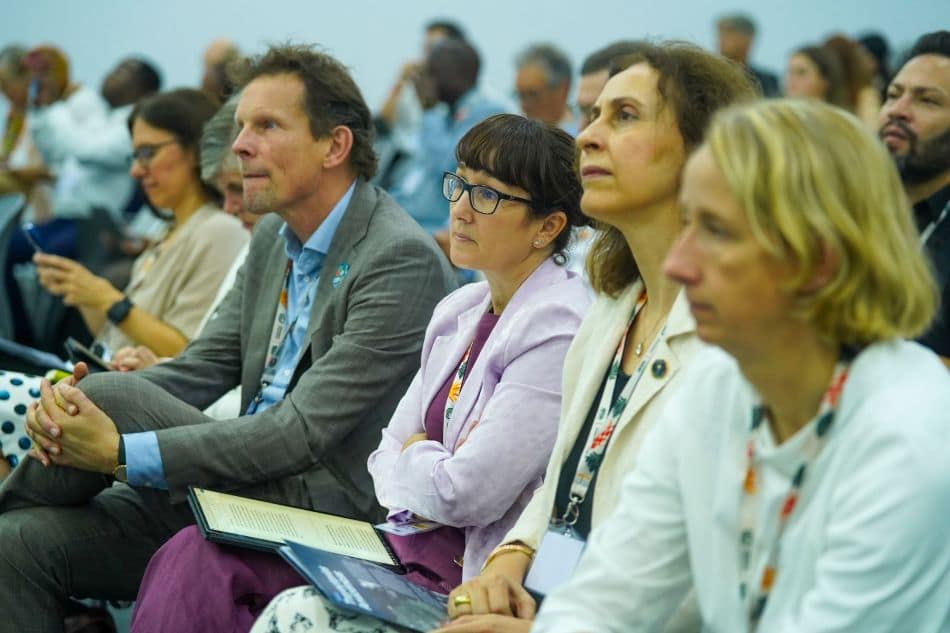
Delivering these commitments requires connecting research and local communities to a broader ecosystem of stakeholders — including the UN, World Bank, NGOs and private financing partners. This connectivity will enable solutions to scale across contexts.
However, this alone is not enough; governments and development partners must center water as a primary consideration. Water-centered interventions can drive solutions across sectors, building resilience among communities that extend far beyond water management alone. This is especially critical for going into the 2026 UN Water Conference, as the focus on the hydrological cycle positions water as a connecting tool across global frameworks to promote collective action.
The promise is there; the tools exist, and finance has been pledged. IWMI will continue to bridge research and implementation, working with partners on water-centered solutions that can move commitments made in Belém from potential to practice.


