

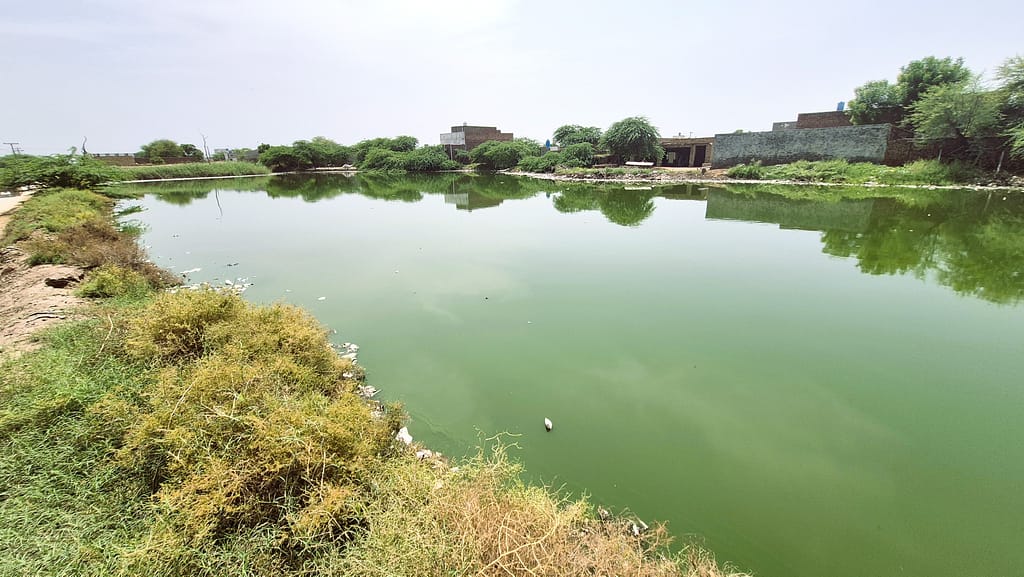
For years, families living in the village of Chak 13/1L in Okara district, Pakistan, structured their daily lives around the moods of a wastewater pond. Doors and windows were always shut to keep out the smell of stagnating water, and children stayed indoors to avoid the clouds of mosquitoes. Every monsoon, things got worse as untreated wastewater spilled out of the pond, sometimes entering nearby homes.
“For many years, water-related problems affected every part of our daily life. With no proper sewerage system, there was a constant foul smell, and dirty water often entered our home. Children fell sick frequently, and illnesses spread easily in the community,” said Jabeen Akhtar, a mother of three whose home is near the pond.
The pond, fed by wastewater from around 100–120 households, had gradually become more than a sanitation challenge. It posed growing health risks, contributed to skin infections, particularly among children, and diminished the value of nearby land. Once a simple wastewater collection point, the pond had become a persistent environmental and social burden for the community.
Across the world, communities facing similar challenges are increasingly turning to nature-based solutions to manage wastewater in ways that are affordable, sustainable and compatible with local ecosystems. One such solution is the floating wetland, a system designed to replicate the natural filtering functions of wetlands to improve water quality.
In Okara, the International Water Management Institute (IWMI) introduced a floating wetland to address the long-standing problems surrounding the pond. The initiative forms part of the UK Government’s Foreign, Commonwealth & Development Office (FCDO) funded Water Resource Accountability in Pakistan program.
A floating wetland to the rescue

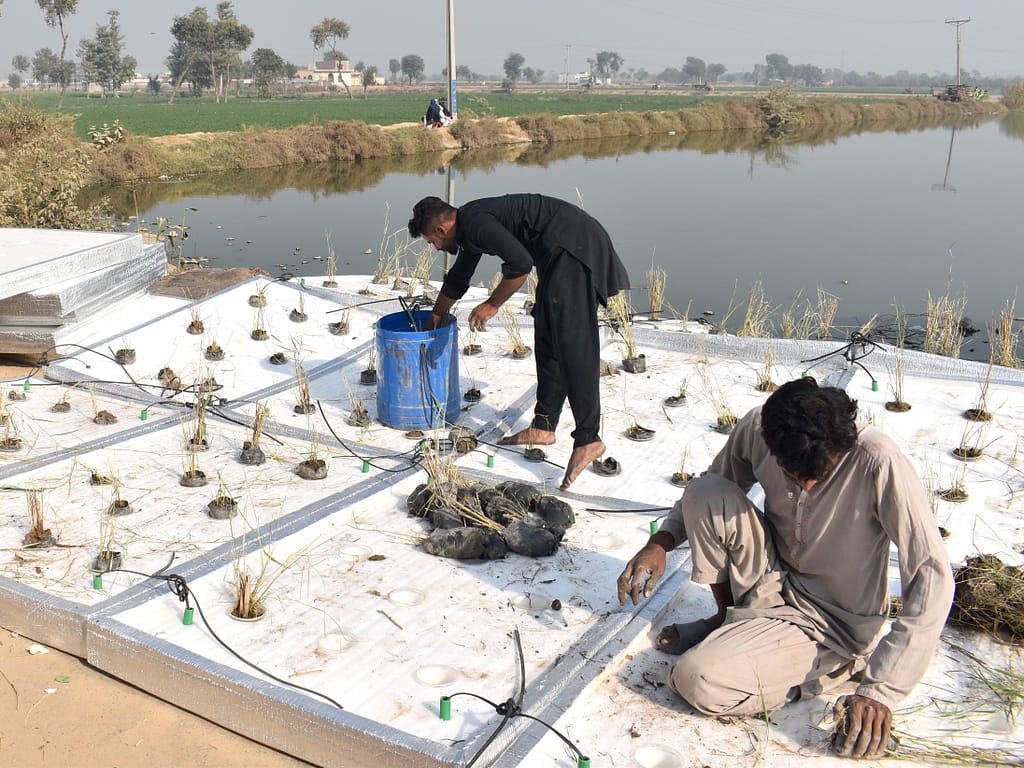
The floating wetland in Chak 13/1L consists of buoyant platforms made from jumbolon and styro-foam sheets, placed directly on the surface of the pond. These platforms support wetland vegetation while allowing plant roots to extend freely into the wastewater below. This facilitates the absorption of contaminants from the water, thereby improving the water quality and removing odor.
“Since the floating wetland was installed and the drainage system improved, the surroundings have become much cleaner,” shared Akhtar. “Environmental pollution has reduced, the smell is no longer a constant problem, and the overall living conditions in our village have improved. This intervention has brought real relief to our family and our community.”
At the heart of the floating wetland system is Common Reed (locally called sar-kanda), a plant well known for its ability to absorb nutrients, organic matter and pollutants. The dense root network beneath the floating wetland acts as a natural filter. The plant roots provide a surface where important naturally occurring bacteria can grow. These bacteria help break down household pollutants such as detergents, oils and kitchen waste. Together, the plants and bacteria improve water quality and reduce foul odor in the pond.
“This pond was receiving wastewater from around 100–120 households, causing severe odor, disease risk and concerns about groundwater contamination,” said Sarfraz Munir, a senior regional researcher at IWMI. “For ponds like this, floating wetlands offer one of the most effective and sustainable solutions. The plant roots naturally absorb contaminants, while beneficial bacteria help break down pollutants more quickly.”
To improve the site’s appearance and ecological value, Canna indica plants were also introduced along the pond’s edges, adding color while supporting habitat diversity. Embankments were reinforced, safety railings were installed and a controlled drainage system was developed to manage excess water during heavy rainfall.
Munir noted that once fully established, the system did more than simply improve water quality. “The treated water reduces odor and improves pond conditions. Over time, it can support aquaculture, creating potential livelihood opportunities for the community, while also encouraging biodiversity.”
Engineering safe water reuse
An important feature of the intervention is how treated water is reused safely. Downstream of the pond, a fully engineered underground drainage system collects treated water and conveys it through subsurface pipes. This approach prevents exposure, damage or recontamination that can occur with open drains.
The treated water is not suitable for drinking, but it meets safety standards for non-potable uses, including irrigation of crops, trees and green belts. During periods of heavy rainfall, the system safely manages excess water, preventing overflow into nearby homes and roads.
By integrating bioremediation with engineering, the system demonstrates how wastewater can be transformed into a productive resource.
A noticeable change for the community
For residents, the difference has been tangible. “Before the floating wetland was installed, stagnant water and pollution made daily life difficult, especially during the rainy season when reaching school was a challenge. With my board exams approaching, these conditions affected my studies. Since the floating wetland, the surroundings have become cleaner, health risks have reduced, and it is now easier to focus on school,” said 14-year-old Minahil Mustafa.
Since the installation of the floating wetland, residents report reduced odor, fewer mosquitoes and improved drainage. Now, on summer mornings, windows swing open to let in not the acrid stench of sewage, but the calls of birds skimming across water. The village’s children spill outdoors at dusk, chasing each other past the same water that once kept them imprisoned inside, transformed now into a wetland where dragonflies hover instead of disease. A nuisance is gradually becoming a shared community asset.
One of the most encouraging outcomes has been the return of wildlife. Before the intervention, poor water quality was repelling wildlife. Today, residents report seeing ducks and other birds resting on the water, a sight rarely observed in the past.
A model with wider potential
While the floating wetland is new to villages, similar approaches have already been introduced in other parts of the country. This pilot reinforces the replicability of floating wetlands as a low-cost, self-sustaining solution for managing wastewater in small towns and villages.
For families living near the pond, the floating wetland represents more than an environmental intervention. It has brought cleaner surroundings, reduced health risks and renewed hope that wastewater can be managed safely and productively.
The project also shows how nature-based solutions, when supported by strong partnerships and locally owned, can improve water governance while enhancing both human well-being and ecosystem health.


