
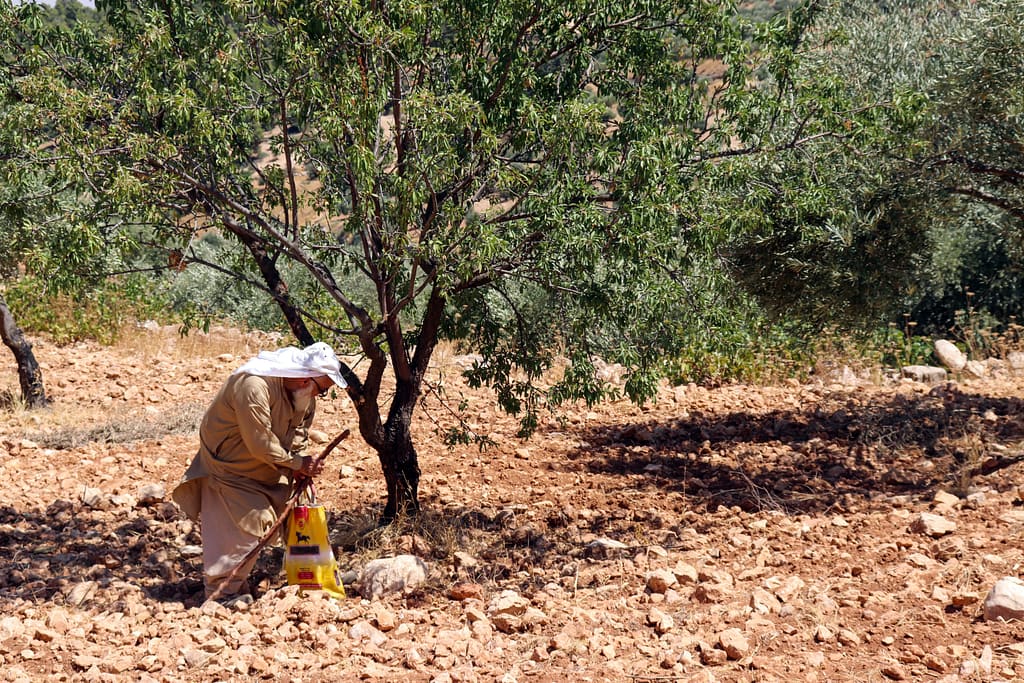
Jordan is one of the world’s most water-scarce countries, facing increasing pressures from climate change, population growth, land degradation and rising agricultural water demand. As these challenges intensify, the country has placed digital water governance at the center of its national water strategy. Reliable data, stronger monitoring systems and improved irrigation performance are essential to support equitable and efficient water allocation.
In response, the International Water Management Institute (IWMI), the Jordan Valley Authority (JVA) and the Ministry of Agriculture (MoA) co-developed the Irrigation Performance Assessment and Diagnostic Tool (IPADT). The tool is based on the Food and Agriculture Organization of the United Nations (FAO)’s open-access database WaPOR, which uses remote sensing to monitor water productivity. IPADT enables institutions to assess irrigation performance at scale and identify how water is consumed across farms, development areas and irrigation schemes.
To advance the integration of IPADT into national systems a stakeholder workshop was convened by the partners in November 2025. The event brought together 40 representatives from JVA, MoA, Ministry of Water and Irrigation (MWI), Water Authority of Jordan (WAJ), National Agricultural Research Center (NARC), University of Jordan, the private sector and development partners. The workshop validated the tool’s technical relevance, assessed its scalability and co-designed pathways for institutional integration into Jordan’s evolving digital water governance framework.
A common need for reliable irrigation data
There is a growing need for consistent, transparent and timely irrigation data. Traditional field-based monitoring is costly, labor-intensive and limited in coverage. By contrast, IPADT uses WaPOR satellite-derived indicators — such as water consumption, crop water deficit and water productivity — to provide a clearer, spatially detailed picture of irrigation performance.
Demonstration cases showed that IPADT can effectively reveal seasonal and spatial variations in water use and crop performance. Sector experts from the Jordan Valley Authority, Ministry of Agriculture and National Agricultural Research Center recognized the tool’s potential to guide planning, identify underperforming farms, prioritize irrigation rehabilitation and assess the impacts of modernization efforts or climate-smart practices. As Hisham Al-Hisa, Secretary General of JVA, emphasized, digital tools like IPADT are essential for ensuring that Jordan’s scarce water resources are used “wisely and equitably.”
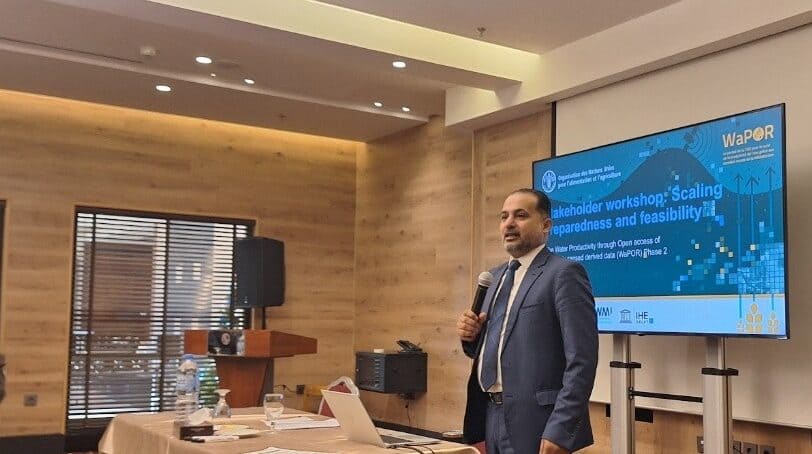
Scaling preparedness at the center
A distinctive component of this initiative was the use of IWMI’s scaling preparedness approach. Rather than focusing solely on technology performance, this approach evaluates the entire enabling environment — policies, institutions, capacities, incentives and stakeholder readiness — to determine whether IPADT can be scaled sustainably.
Participants engaged in a series of structured exercises designed to holistically assess the readiness of IPADT for scaling. These exercises explored the current maturity and robustness of IPADT as an integrated innovation package, while also examining users’ levels of awareness, demand and digital capabilities that influence adoption. In parallel, discussions considered the adaptations required to align IPADT with Jordan’s institutional and legal context and identified key system enablers and bottlenecks that could either facilitate or constrain scaling efforts.
Experts highlighted that while IPADT is technically robust and has been refined through a three-year co-development process, successful scaling will require further contextual adjustments. Key priorities include improving the user interface to accommodate a wider range of institutional users, aligning outputs with national cropping calendars, tailoring data access to different user needs and expanding training programs. Partners emphasized the importance of continued capacity development — particularly in remote sensing and the interpretation of WaPOR-based indicators — to build user confidence and support broader adoption.
Emerging scaling pathways
During the co-development process, partners identified a phased scaling approach. The initial focus will be on targeted verification exercises in selected farms in the Northern Jordan Valley (NJV). WaPOR data validation and hands-on training for staff from JVA, MWI, MoA and NARC will demonstrate the tool’s practical value. As confidence increases, IPADT can gradually be integrated into routine monitoring and connected with national digital dashboards.
Over time, the tool could be deployed across the entire Jordan Valley. However, participants acknowledged that the current WaPOR Level 3 (20-meter resolution) data does not yet fully cover the whole region, which may require expanding satellite data production to support full-scale deployment. At a 20-by-20-meter scale, WaPOR Level 3 imagery offers detailed field-level insights into water and crop conditions, making it especially valuable for irrigation planning once available at scale. Formalizing IPADT within national water strategies and data-governance frameworks will also be necessary to ensure long-term sustainability and continuous improvement.
Enablers for scaling
Stakeholders highlighted a set of reinforcing strengths that create favorable conditions for scaling IPADT in Jordan. Strong government commitment to digital transformation in the water sector provides a supportive policy backdrop, complemented by growing national expertise in geographic information systems, remote sensing and other digital systems across institutions such as Jordan Valley Authority, National Agricultural Research Center, the Ministry of Agriculture and universities.
At the same time, water-use efficiency and climate adaptation are firmly established as national priorities, increasing the relevance of IPADT for decision-making. This is further reinforced by rising demand for harmonized and reliable datasets to support planning and reporting, alongside the expanding use of satellite-based monitoring and AI-generated data. Together, these factors position Jordan well to integrate IPADT into routine institutional workflows, provided that coordination mechanisms and data-sharing protocols are strengthened.

Challenges to overcome
Despite strong momentum, challenges remain. Data systems are fragmented and often lack interoperability as platforms use different standards and formats, limiting data exchange and cross-agency coordination.
Some users are hesitant about satellite-derived indicators, underscoring the need for ongoing training and trust-building. Limited financial resources, governance complexities and the need for continuous user engagement — especially with field-level staff — may also slow scaling. Participants agreed that scaling must be gradual, adaptive and focused on priority areas that rely heavily on freshwater resources.
Toward a digital water future
Scaling digital tools is not only a technical endeavor but requires institutional collaboration, systems thinking and governance readiness. IPADT holds significant potential to support Jordan’s goals for higher water productivity, climate-resilient agriculture and transparent irrigation management. When combined with other digital solutions — such as smart water management, data services and digital data collection, IPADT can form the foundation of a more integrated, data-driven irrigation ecosystem.
IWMI will continue working with national partners and FAO to strengthen capacities, co-develop solutions and embed remote sensing data into everyday decision-making.