

I grew up on a farm in South-West England, and I know from childhood the feeling of deep anxiety watching the weather forecast predictions for too much rain or too little. What I see now, working across Asia, Africa and Latin America, is the same worry writ large — families and farmers navigating increasingly unpredictable water, doing what they can with the tools they have.
What keeps me going is that there are tools that work. Better water storage, drought-tolerant crops and early warning systems — when these align with political will and funding, real change happens. The Commission on Water for Food Futures (CWFF) exists precisely to help make that alignment more likely, more often.
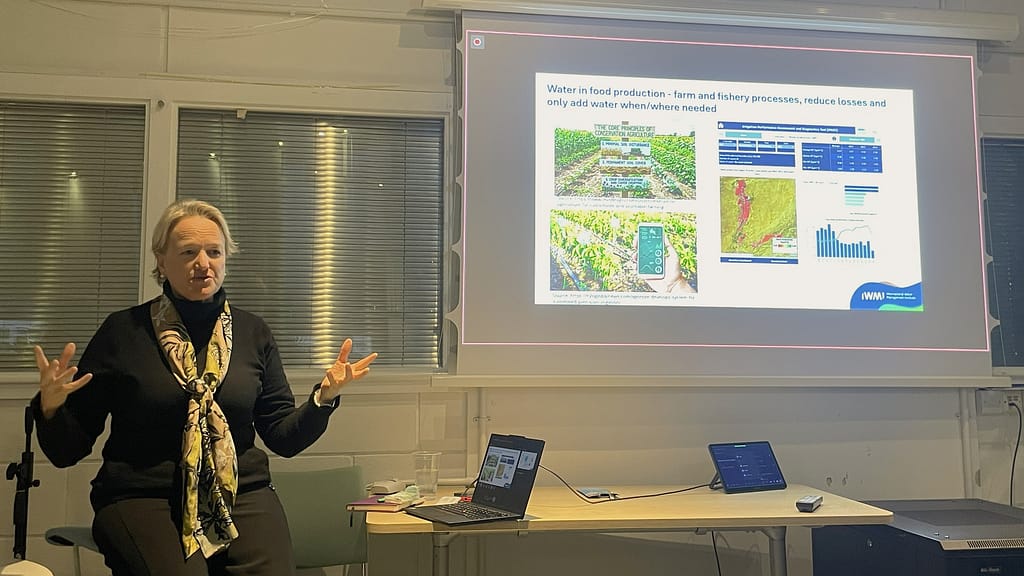
This March, I had the privilege of speaking at the Cambridge Festival as part of our work on the CWFF — a new Cambridge Sustainability Commission, led by the International Water Management Institute (IWMI) and the Daugherty Water for Food Global Institute. CWFF also brings together the Cambridge University Press and the non-profit organization, Collective Action for a Water-Secure World (C4W). The Cambridge Festival is an annual celebration of the arts, sciences and ideas that shape our world, and as we mark World Water Day, I wanted to reflect on this conversation that touched on some of the most urgent questions facing our planet.
A crisis already unfolding
It is tempting to frame water and food insecurity as a distant threat on the horizon. It is not.
Today, 318 million people are facing severe hunger — more than twice the number in 2019. Agriculture accounts for roughly 70% of the world’s freshwater withdrawals, and increasingly volatile rainfall, floods and droughts are disrupting harvests across the globe. With the predictions for a strong El Nino looming, this is only likely to increase in the coming year. Local shocks cascade into global ones, as crop failures push up prices felt by everyone, everywhere.
Looking ahead, by 2050 over 80% of the world’s croplands could experience water scarcity if current drying trends continue. And yet the story is not simply about water. Conflict remains the single biggest driver of hunger, affecting nearly 70% of people experiencing acute food insecurity.
These crises are interconnected — and so must be our responses.

Agriculture as restorer, not just consumer
One of the most important shifts in how we think about farming is the recognition that agriculture does not have to be a net drain on water. Healthy soils absorb and slowly release water, recharging groundwater and sustaining rivers. Practices like cover crops, reduced tillage, diverse crop rotations and agroforestry can rebuild this capacity.
This reframing matters for another reason. Farmers — from smallholders managing a few hectares to large-scale irrigators drawing on shared river systems — are arguably the world’s largest group of water managers. They make decisions every day that shape how water moves through landscapes, aquifers and catchments. Yet they are too often absent from formal conversations about water and food security that happen in policy forums and international negotiations. If we are serious about transforming water use across food systems, farmers cannot simply be the recipients of decisions made elsewhere. They need to be at the table — their knowledge, their constraints and their innovations recognized as essential to finding solutions that actually work on the ground.
The evidence is already compelling. In the United States of America, improved irrigation methods saved billions of megaliters of water between 2019 and 2023. In California, farmers are actively recharging depleted aquifers during wetter periods, using their land as a natural sponge. The potential — ecological and economic — is enormous, but so is the challenge. The shift from extraction to stewardship is not a distant aspiration; it is already happening, driven in many places by farmers themselves.
Why action cannot be delayed
This is perhaps the hardest message to land — not because it is complicated, but because it is uncomfortable. The decisions we make now, in the next few years, will lock in infrastructure, land use and food systems for our future. Aquifers being depleted today take decades to recharge; some may not recover at all. Children who are malnourished today will carry those consequences for life.
Around 2040, global population is expected to peak, climate impacts are projected to intensify significantly, and the gap between water supply and demand will become very difficult to bridge through technology or trade alone if current trajectories hold. The window for systemic change — in farming practice, diet, investment and political will — is not indefinitely open.

What the Commission is finding
The Commission on Water for Food Futures is structured around four interconnected themes: using all water sources wisely in food production; building fairer institutions for water governance; making markets work better for water; and aligning diets and consumption with water realities. The work draws on consultations with over 1,000 stakeholders and 440 institutions across Africa, Asia and Latin America, and it is already surfacing some genuinely exciting innovations.
Digital water management tools — sensors, digital twins, real-time analytics — are enabling precision at scale. Advances in crop bio-breeding are producing varieties that thrive under water stress or salinity. Circular economy approaches are turning wastewater and food-processing water into resources rather than waste, recovering nitrogen and phosphorus and closing loops that linear systems leave dangerously open.
On diet, the picture is nuanced. Global evidence points to significant water savings from shifts toward less processed, more plant-based food — but there is no universal prescription. Traditional and regional diets often perform well on both nutrition and water efficiency. Part of the answer may lie in recovering and strengthening what communities already know, not in imposing solutions from outside.
Why this conversation belongs at a festival
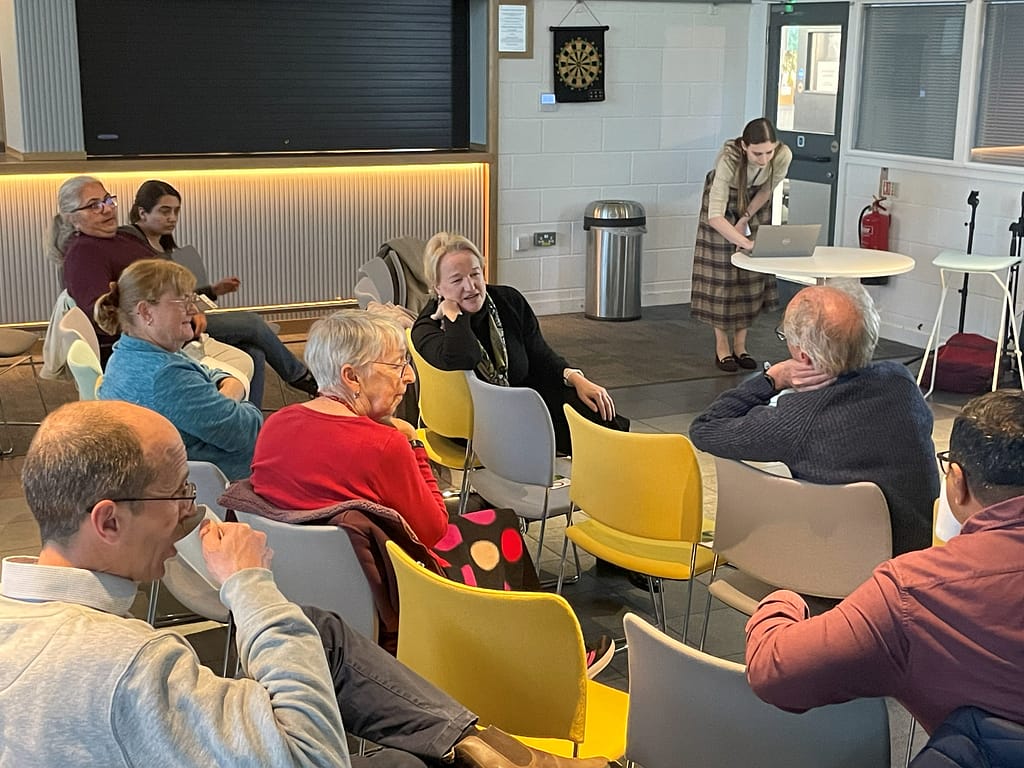
The Commission will publish its high-level report in 2027, alongside a range of shorter, more accessible outputs. But the point of an event like the Cambridge Festival is something a policy brief cannot achieve on its own: it can make us feel the weight of water and food insecurity in a way that changes how we think, what we ask of politicians, and what we choose to put on our plate.
Food and water decisions are made everywhere — in supermarkets, schools, farms, local councils and kitchens. That includes farmers, who are not just producers of food but stewards of water at a scale no other group can match. Experts can identify the path. It is people — farmers, consumers, policymakers and citizens — who have to decide to walk it. That is why public understanding and public demand are not peripheral to solving this crisis. They are central to it, and the rich discussion in Cambridge was just the start.


