By 2030, global demand for water will outgrow supply by 40%. Global commitments to water are more critical than ever as progress on water security remains fragmented. As the 30th UN Climate Change Conference of the Parties (COP30) approaches, we take stock of how global water policy has evolved to better understand both the successes and shortcomings of commitments to water.
International water policy milestones
In 1977, the United Nations (UN) convened the first Water Conference, recognizing water as a basic human need. Since then, the conversation around water as a critical and threatened resource has continued to grow through international conferences. Key milestones include the 1992 International Conference on Water and the Environment in Dublin, Ireland; 1992 Earth Summit in Rio de Janeiro, Brazil; 2002 World Summit on Sustainable Development in Johannesburg, South Africa; and the adoption of the Sustainable Development Goals in 2015, which contained a dedicated goal for clean water and sanitation (SDG 6).
In 2023 — 46 years after the first Water Conference — the UN held the second Water Conference, a pivotal moment at which water challenges were recognized as a global crisis. The 2023 Conference resulted in over 700 voluntary commitments and billions in funding committed towards a water-secure future.
The same year, at COP28, targets were set to reduce climate-driven water shortages, protect against water-related disasters and ensure safe, affordable drinking water and sanitation for all.
Despite these efforts, global action on water lags far behind growing threats to water resources. This gap disproportionately impacts vulnerable communities that are most exposed to water-related crises.
The outcomes of COP29
Last year, at COP29 in Azerbaijan, negotiators agreed on a new global climate finance target. A minimum of $300 billion annually was committed for climate action in developing countries by 2035. While significant, these pledges still do not reach the estimated $1.3 trillion needed annually to meet their needs, including up to $200 billion per year needed for water infrastructure and services alone.
Much of the climate finance available today is delivered as loans to developing countries, often with interest. This financing model can reinforce, rather than relieve, existing resource challenges in addressing global water needs. Meanwhile, fragmented governance and weak policy implementation persist. These challenges are particularly pronounced in transboundary water resources where inadequate monitoring, reporting and information sharing hinder coordinated action.
COP30, taking place from November 10–21, was designated the “Implementation COP” by host country Brazil with the intention of turning pledges into tangible action. This year’s COP offers a critical juncture to assess progress and push for stronger, coordinated climate resilience measures.
Scientists are already researching solutions to address global water risks. However, successful implementation at scale requires countries’ sustained commitment and investment.
How IWMI is shaping the global water agenda
As a research-for-development center, the International Water Management Institute (IWMI) drives water security through evidence-based, systems-oriented research that produces actionable science and informs policy and investment by convening partners at national, basin and global levels.
As the host of the Secretariat of the Global Commission on the Economics of Water (GCEW), IWMI is helping move water commitments off the page and into budgets, reforms and investment agendas. For example, at the Ramsar Convention in Zimbabwe earlier this year, IWMI and GCEW reinforced the critical role of wetlands not just as ecosystems to protect, but as vital infrastructure for resilience. This convention resulted in the Victoria Falls Declaration, which emphasized the need for increased financial investment, speed and commitment to wetland conservation. The Commission’s report on valuing the hydrological cycle as a global common good further shifts priorities and discourse on how countries understand, value and govern the water cycle.
This urgency to integrate green water and the hydrological cycle into international frameworks is gaining traction in global dialogues, such as the Stockholm World Water Week. IWMI also participates directly in global advisory fora and governance bodies to amplify research into policy, including advisory inputs to G20 and other multilateral discussions — where it promotes data-driven approaches to water security.
IWMI has also been working on designing and promoting accessible tools to create more efficient water management. Through the Digital Twin project, IWMI researchers created a model of the Limpopo River Basin to transform the intersection between water management and technology. The Digital Twin works by integrating real-time monitoring data, satellite images, modelling and historical data to create an accurate virtual representation of the Limpopo River Basin.
Tools like the Digital Twin are paving the way for high-quality and equitable access to information systems. With such technology, e-flow assessments can gather data more quickly and easily at a relatively low cost and on a larger scale.
IWMI also engages through applied projects that inform policy and institutional practice. In July 2024, IWMI and partners introduced the Water Resilience Tracker (WRT) — a tool designed to help countries assess and strengthen their climate strategies to better withstand water risks. Costa Rica, Egypt, Malawi and Brazil have introduced the tracker, engaging more than 50 government and non-governmental stakeholders. Other countries, such as Ecuador, Bolivia and Indonesia, have also voiced interest in using the tracker. The WRT has become a key tool for countries to increase water action in their climate commitments. As countries and stakeholders prepare for COP30, IWMI’s efforts illustrate how collective action can weave water into the foundation of climate resilience.
IWMI and COP30

At COP30, IWMI’s delegation of experts is committed to bridging water research and management planning with strategic pathways to implementation.
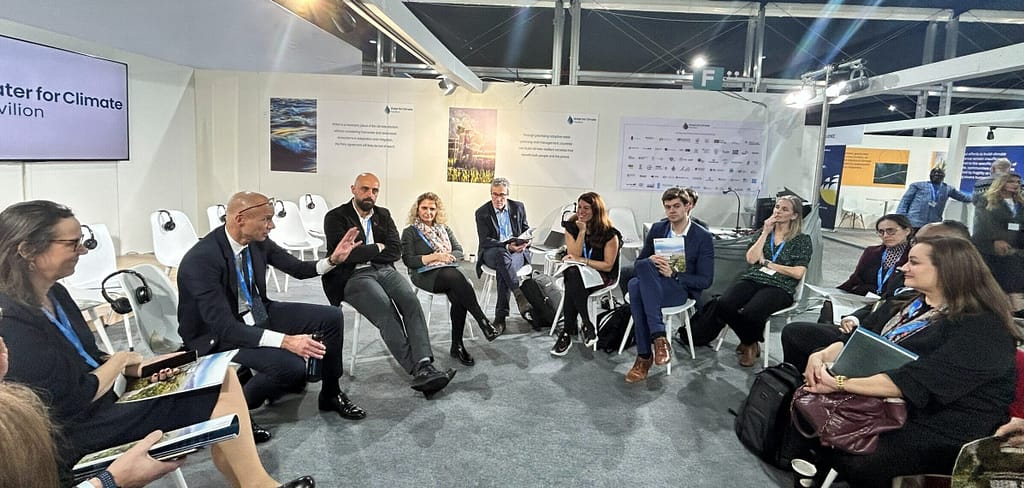
In collaboration with governments, NGOs and civil society partners, IWMI is co-hosting events at COP30 to advance an intersectional, holistic approach to water management towards effective climate action. These include an event in coordination with the Government of the Netherlands to discuss a global, systemic approach to hydrological resilience, as well as a discussion on aligning economic growth with climate security in partnership with the Global Commission on the Economics of Water.
“As COP30 approaches, efforts to address water challenges must accelerate. Strengthening data accessibility, governance and inclusive participation must remain part of the top international priorities to ensure that vulnerable communities are protected and empowered, and water challenges are being addressed effectively,” said Vidhisha Samarasekara, strategic program director of IWMI’s Water Climate Change and Resilience team.
COP30 can be a turning point for water to remain at the heart of climate solutions, paving the way for a dedicated international framework that treats water as critical for climate adaptation. IWMI is committed to driving this forward-looking agenda — promoting innovative and collaborative approaches to water management.