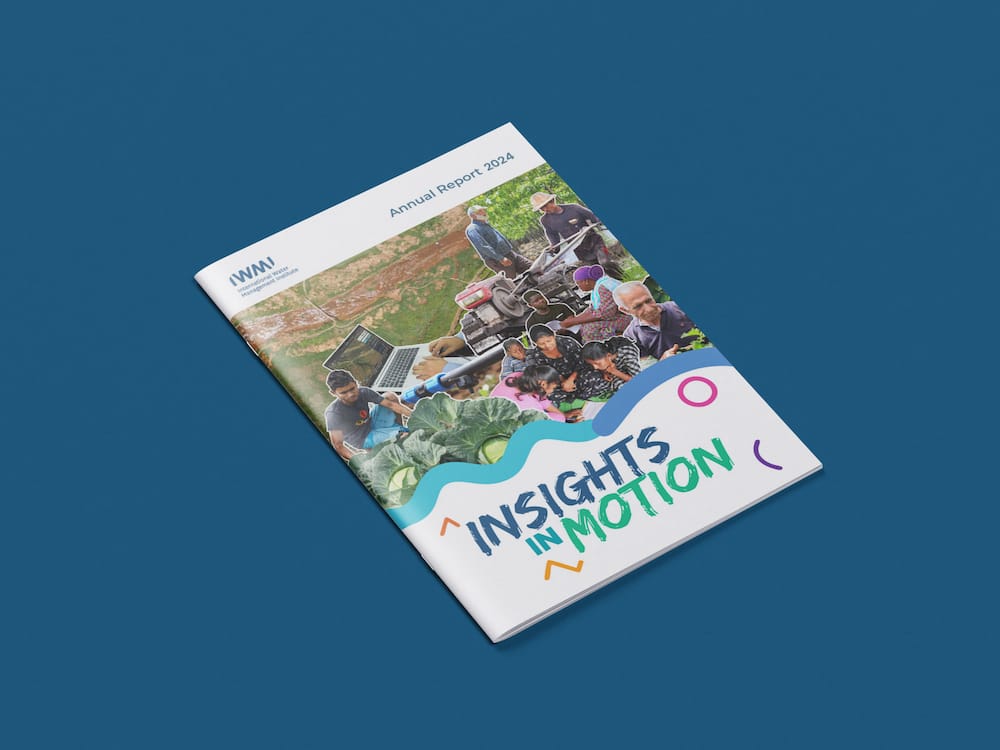
The International Water Management Institute’s (IWMI) Annual Report 2024: Insights in Motion highlights a year defined by strong scientific research, strategic partnerships, and advances in water security across the Global South. 2024 was a key year for the organization, reflecting on its legacy as it celebrated its 40th anniversary and looking ahead as it launched its new IWMI Strategy 2024–2030.
In 2024 IWMI produced and shared evidence, in the form of research publications and data; contributed to important policy reforms and governance frameworks in countries confronting acute water risks; and pioneered innovations and solutions for water security.
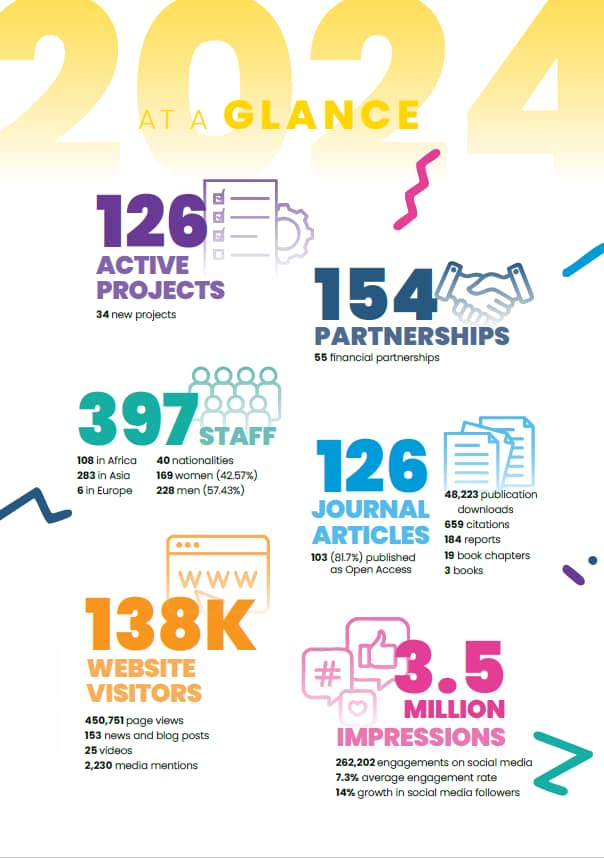
The Institute’s research footprint remained strong in 2024, with 126 journal articles, 184 reports, 19 book chapters and three books published.
IWMI’s activities expanded significantly in 2024 with 34 new projects, bringing its active portfolio to 126 projects. Across transboundary basins, IWMI collaborated in more than ten shared river systems — including the Ganges, Indus, Limpopo, Mekong, Nile, Volta, and Zambezi — supporting integrated management strategies and cooperation among governments and regional authorities.
Financially, 2024 was a strong year for IWMI, with a 23.6% increase in grant income. IWMI worked with 154 partners, reinforcing its strategy of deeper, more equitable collaboration.
With the new strategy as its compass, the organization is positioned to drive global transformation in water management, supporting informed decision-making from grassroots communities to international policy forums.
Evidence: Closing critical water gaps
In 2024, IWMI deepened its investment in water governance by addressing one of the most persistent constraints facing decision-makers across Africa and Asia — the lack of reliable and actionable water data.
A flagship achievement was the release of the most detailed river discharge dataset ever produced for Africa, covering nearly 64,000 stream segments over a 20-year period. Developed under the Digital Innovations for Water-Secure Africa (DIWASA) project, the dataset helps close critical information gaps in Africa’s hydrological records, where until now discharge data was available only for just 0.7% of the continent’s rivers through the Global Runoff Data Centre. By filling this gap, IWMI is enabling more informed decisions on irrigation planning, hydropower development and climate risk management.
Beyond hydrology, IWMI expanded the use of artificial intelligence (AI) and machine learning to make climate data usable in climate-vulnerable contexts. In Myanmar, the Aquaculture Decision Support Tool (Aqua-DST) integrates flood risk, water scarcity and pond suitability data to guide climate-resilient aquaculture investments. In Southern Africa, a digital twin of the Limpopo River Basin offers a virtual representation of the basin that integrates near real-time data, simulations and AI, to enable decision-makers to test scenarios and anticipate future risks.
IWMI’s focus is not only on producing data, but on ensuring that evidence is co-designed with users and translated into insights that inform real-world decisions.
Policy: Turning science into decision-making power
IWMI’s evidence base continued to inform policy reform and governance processes at national, regional and transboundary levels in 2024. Across the Global South, governments are under growing pressure to align water management with climate commitments, yet often lack the tools and institutional coordination to do so effectively.
IWMI supported national authorities in Brazil, Egypt, Malawi, and Nepal using the Water Resilience Tracker — a diagnostic tool that helps countries access water risks and strengthen water resilience within national climate action plans. In Malawi, the tracker underpinned preparations for a national Water Security Leadership Forum, convening actors from government, finance, business and civil society around shared priorities for reform and investment.
In Sri Lanka, IWMI’s longstanding policy engagement translated into measurable governance gains. The GeoGoviya smart farming platform, developed with government partners, streamlined agricultural databases and digital payments, reaching 1.42 million farmers and saving national authorities $1.6 million by eliminating duplicate records and improving the efficiency of fertilizer subsidy transfers. The platform also provided tailored advisories to help farmers manage climate risks.
Solutions: From innovation to scalable impact
Across regions, IWMI translated evidence and policy engagement into practical solutions that respond to local needs while addressing systemic challenges. In the Lower Mekong region, encompassing Cambodia, Lao PDR and Myanmar, IWMI launched new tools to integrate fisheries into irrigation planning. This was a critical step in helping reverse declining fish stocks and safeguarding local food security. Developed with partners, these tools help planners identify where irrigation and fisheries can coexist, making aquatic food systems more visible in water allocation decisions. In Morocco, IWMI co-developed an online Water Accounting Dashboard for the Souss Massa River Basin, which provides crucial data on water availability, usage and future projections. By improving transparency and shared understanding, the platform supports more equitable allocation decisions in one of the country’s most water-stressed regions.
At the global scale, IWMI contributed to 22 of CGIAR’s 33 Initiatives, reinforcing its role in shaping system-wide policy agendas. The institute co-led two major CGIAR programs: Ukama Ustawi, focused on food security, and NEXUS Gains, which promotes holistic systems thinking in water resource management — ensuring that water governance is embedded across development priorities rather than treated in isolation.
These solutions reflect a consistent theme running through IWMI’s 2024 Annual Report: progress depends on linking innovation with institutions, and technology with trust. Whether through digital platforms, basin-level dashboards or integrated planning tools, IWMI’s work demonstrates how water science can guide communities through climate uncertainty towards more resilient water systems.