

It was a moment of validation for the scientific community when the recent Union Budget (2018) of India brought to light a new scheme called Kisan Urja Suraksha Evam Utthaan Mahaabhiyan (KUSUM), for promoting solar farming. With an allocation of USD 21.8 billion, the government plans to start building 10,000 MW solar plants on barren lands, providing 1.75 million off-grid agricultural solar pumps. Through the scheme, farmers’ income levels are projected to see a sharp rise as they will be given an option to sell surplus power generated to the local power distribution companies (DISCOM).
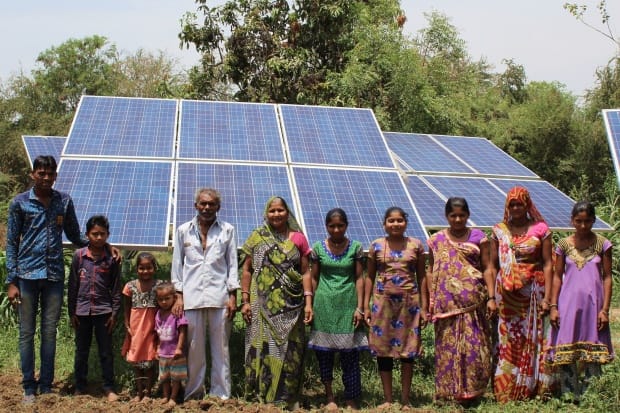
The announcement has brought in a sense of jubilance for researchers at the International Water Management Institute (IWMI) and the CGIAR Research Program on Climate Change, Agriculture and Food Security (CCAFS) who, with support from Tata Trust and the CGIAR Research Program on Water, Land and Ecosystems (WLE), set up the first ever solar pump irrigator’s cooperative in Dhundi Village of Gujarat. This climate-smart initiative has been a novel intervention in the sense of the approach of farmer led and owned ‘cooperatives’. Since its inception in 2015, it has been hailed by stakeholders, especially the state policymakers as a model of reference to be scaled for attaining multiple benefits of income growth, regularization of power, sustainable ground water use and de-dieselising of agriculture leading to a curb in carbon dioxide emissions.
In fact, with escalating interest in its visible impacts, the Gujarat government had felicitated the solar cooperative members with a certificate of appreciation awarded to the same, by the Chief Minister of Gujarat on the occasion of Krishi Mahotsav or Agriculture Festival in 2016. In the following year, the site was visited by representatives from the Ministry of New and Renewable Energy of the government of India.
Taking account of the mounting interest of policymakers in the model, we engaged in a dialogue with the Finance Minister during pre-budget consultations with experts in the agriculture sector, to elaborate on the benefits of this model on scaling. The Dhundi model was also presented to the Prime Minister in a consultation with eminent economists organized by Niti Ayog (principle policy think tank of government of India) on 10 January 2018. Such efforts have come full circle with the Finance Minister of India announcing during the budget session: