

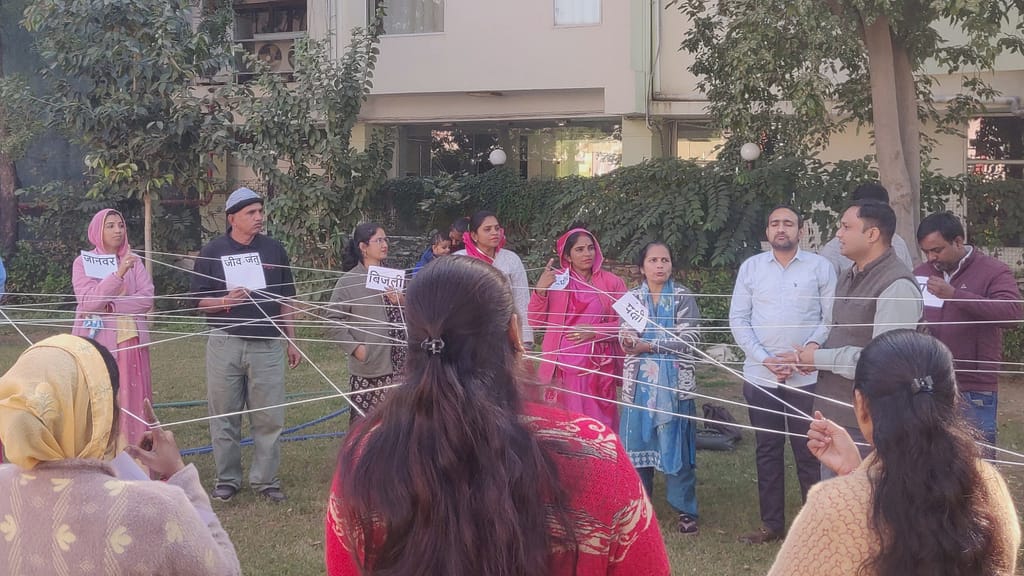
Participants stand in a circle on the lawn, connected by crisscrossing threads. Each represents an element: soil, crops, animals, rivers, air, humans or water. As one element steps out, the tension in the web shifts; when two leave, it weakens further; but when the “water” element withdraws, the entire network collapses. This is the “ecological balance” workshop game, which shines a light on the relationship between people and their ecosystems.
Such an approach may prove vital to addressing the groundwater crisis in India, where 25% of the world’s groundwater is extracted, primarily for agriculture. Despite sustained investments and technical interventions, many groundwater-dependent regions remain highly vulnerable. Groundwater is a shared resource, and as such, communities need to recognize their collective role in safeguarding it. Evidence suggests that the missing lever is behavioral and institutional rather than technical.
Cognitive shifts connect people to their collective action
In November and December 2025, Training of Trainers (ToT) workshops were conducted in Rajasthan, India, for civil society and government stakeholders. The trainings were led by the Centre for Microfinance (CmF), with technical support from the International Water Management Institute (IWMI). The ToTs used games and interactive exercises to deepen participants’ understanding of shared water resources and the principles of collective leadership.
The water crisis game, for example, invites participants to reflect on everyday water-use decisions. In this role-play exercise, three participants assume the roles of a grandparent, parent and child, sThe water crisis game, for example, invites participants to reflect on everyday water-use decisions. In this exercise, three participants assume the roles of a grandparent, parent and child, symbolizing successive generations within a household. Each withdraws water from a shared tub using syringes of increasing size. Even when modest amounts of rainfall are intermittently added, the tub empties as extraction intensifies, illustrating how escalating demand can surpass natural recharge over time.
An idea of leadership begins to appear at this point. As participants see the shared tub running low, their behavior often starts to change — not through a leader exercising their authority, but by participants acknowledging and discussing their shared problem, and agreeing to think and act collectively to establish a system of water extraction based on needs.
A self-assessment exercise can also be used to encourage participants to redefine leadership. Assuming the role of village leaders, participants are asked to imagine a village and collectively assess its overall health. Participants evaluate water availability, community participation, livelihood resilience and institutional coordination.
In Jaipur, participants went on to articulate the qualities and responsibilities of leaders they admired. Honesty, empathy, listening, courage and fairness emerged as desirable traits. Throughout, they confronted a simple idea: if groundwater is a shared resource, then collective leadership is the best way to ensure its sustainability. What unfolded was a leadership laboratory in how powerful ideas take root and reorganize how people think, act and lead
The psychology of groundwater decisions
The most revealing moment came during the “leadership barriers” exercise. For civil society organizations (CSOs), skill-related barriers emerged as the most significant challenge, indicating insufficient access to information, limited facilitation practice and technical confidence. Personal and mental barriers followed, with participants sharing that fear of judgment, self-doubt and hesitation to speak publicly held them back. Social barriers, which came in next, often stemmed from local politics, social norms or community resistance.
The challenges were different for government officials, including representatives of Rajasthan State’s rural livelihoods program. Personal and individual barriers were most prominent, reflecting workload pressures, stress and limited space for reflection. Skill-related challenges preceded community-level constraints, suggesting that while technical knowledge is generally strong, managing community dynamics and maintaining personal well-being remain key challenges.
Taken together, the evidence suggests that groundwater challenges are shaped not only by technical limitations but equally by behavioral and capacity-related constraints that circumscribe leadership effectiveness.
A collective vision for an ideal village
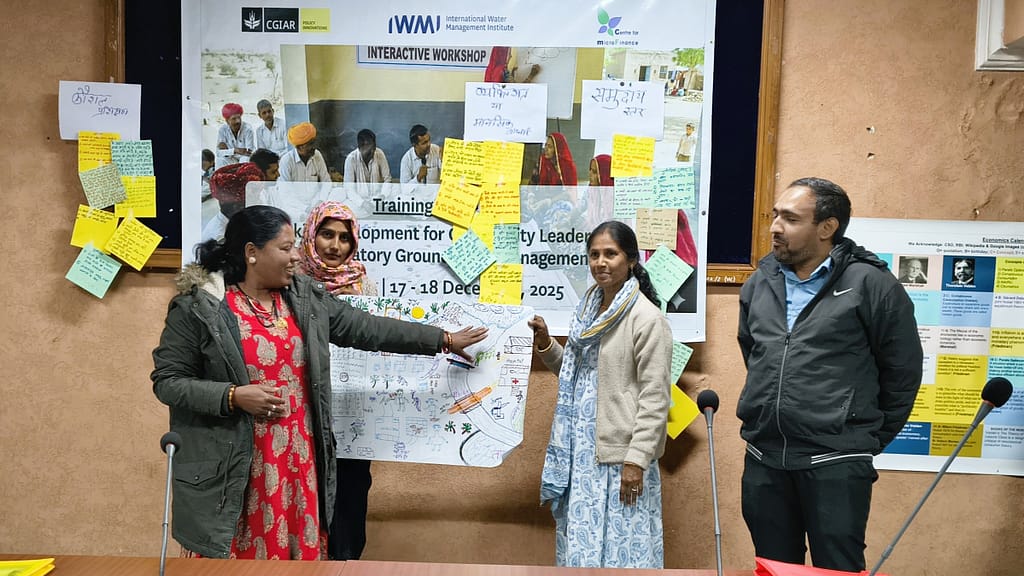
Finally, in the “village of my dreams” game, a participatory visualization exercise involving group scenario-building and drawing, participants mapped their ideal village – one that was water-secure, equitable and ecologically balanced. They placed water structures at the center, imagined pathways of collective work, defined roles for women and youth and envisioned leaders who could connect, mediate and mobilize.
As noted by leadership scholar Warren Bennis in 1989, visioning is the moment an idea moves from abstraction to embodiment. When people draw the world they want, they implicitly define the leadership they need.
“The leader in our dream village is not someone we wait for. It is someone we become,” said Kiran Ji, a master trainer with the Rajasthan Grameen Aajeevika Vikas Parishad (RGAVP), reflecting on her experience.
How ideas take root in practice
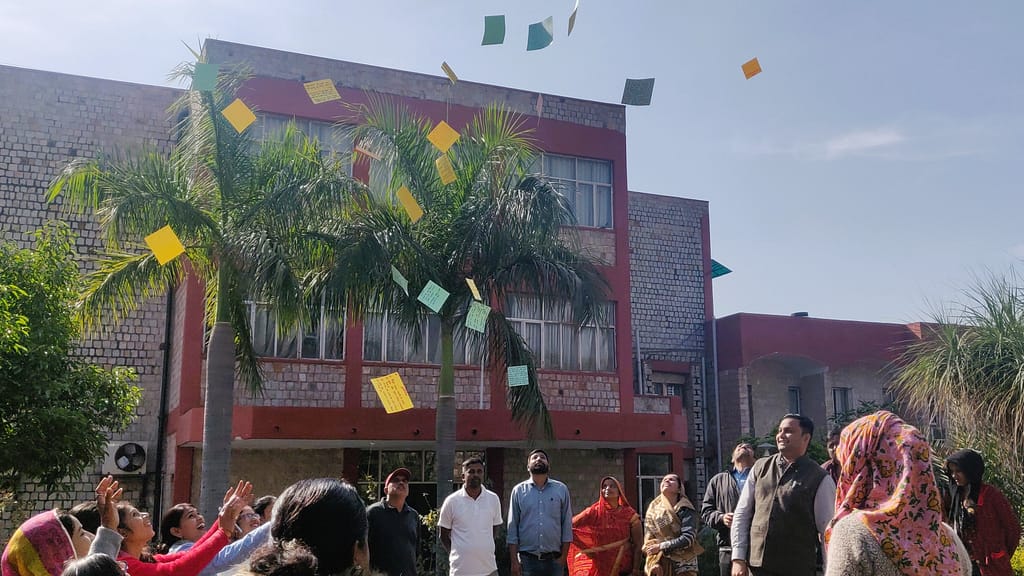
These workshops adopt a participatory approach to move beyond prescribing technical solutions. They help government officials and civil society members see groundwater as a collective management challenge relevant to their on-the-ground roles.
In Jaipur, CSO participants found that this approach resonated strongly with their field realities. They valued the hands-on exercises and local case discussions, which helped them connect broader ideas such as water budgeting to their own realities — for instance, linking crop choices and local water scarcity to planning discussions. The focus on facilitation skills and adaptive communication was seen as particularly useful for their engagement with diverse stakeholder groups.
Government officials offered more measured responses. While many appreciated the relevance of participatory tools to their institutional contexts, others called for more explicit linkages to departmental procedures and operational demands. For them, the ToT’s strength lay in demonstrating how leadership and collaboration could complement technical expertise within their existing roles.
Amidst a flood of data-backed findings, it is easy to forget that ideas fail because they do not take root in practice. Participatory approaches that build collective leadership can translate groundwater knowledge into action – for instance, by equipping local actors with skills to facilitate village water budgeting, steer discussions on crop and water use, and nurture cooperation around shared aquifers. Peer learning, contextual problem-solving and subtle behavioral nudges can enable communities to reflect on their water decisions and plan collectively. Such approaches recast groundwater from a purely technical concern into a shared governance challenge.
India’s groundwater future will hinge not only on engineering solutions, but also on communities able to deliberate, plan and act in concert. When embedded in everyday village decision-making, these capacities form the foundation of more adaptive and locally grounded groundwater leadership


