

The Asian Water Development Outlook (AWDO) is the leading water security assessment for Asia and the Pacific, led by the Asian Development Bank (ADB). Launched on December 8, AWDO 2025 assesses water security across five key dimensions, ranging from rural households, economic, urban, environmental to water-related disaster security.
Since 2013, the International Water Management Institute (IWMI) has led the assessment on Economic Water Security — measuring whether countries have enough reliable water to sustainably support economic growth and reduce vulnerabilities to water-related disruptions.
AWDO 2025 reports that 2.7 billion people across Asia and the Pacific have escaped extreme water insecurity over the past decade, marking one of the region’s most significant development gains. But the report warns that these advances are increasingly at risk as environmental pressures intensify, climate-driven hazards rise and investment in water systems falls short.
Zooming in on the economic dimension shows why the gains remain fragile. AWDO’s Economic Water Security assessment finds that while water security has improved modestly across the region over the past decade, progress is uneven across countries and income categories. The outlook stresses that “inclusive, integrated water management” is essential to anchor the region’s long-term economic resilience.
To assess the economics of water security, the report looks into four sectors — the broad economy, agriculture, energy and industry — to produce a composite score for each country. It evaluates water availability and security, along with how effectively countries manage, allocate and govern their water resources to support productivity, resilience and inclusion.
Water security emerges as a defining challenge for Asia and the Pacific
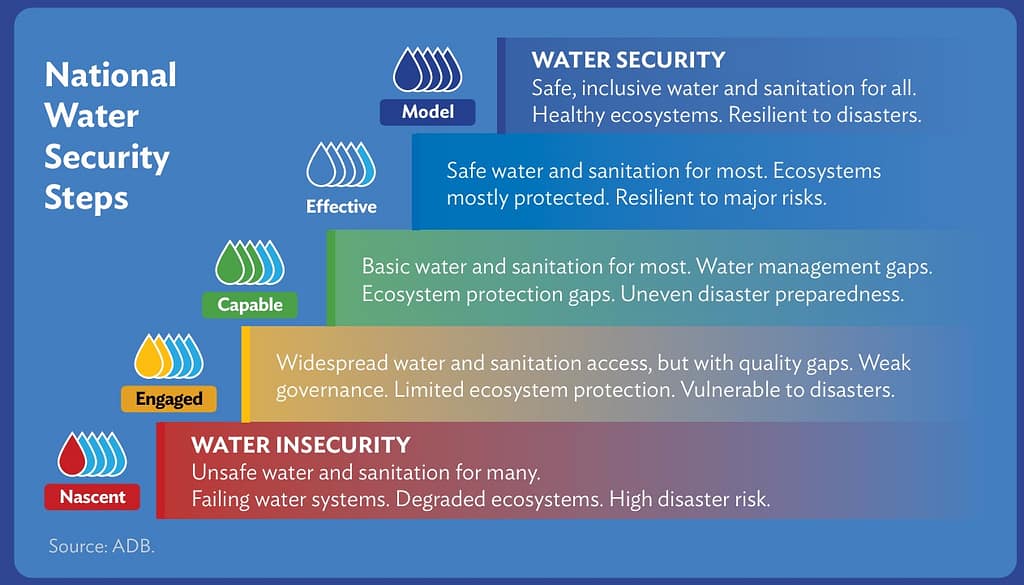
The average score for economic water security across Asia and the Pacific rose from 11.15 in 2013 to 13.7 in 2025, reflecting slow but steady improvement. No country reached the “model” category, and over half remain in the “engaged” tier, where key enabling conditions remain unmet.
Economic water security varies sharply across Asia and the Pacific. Advanced economies in East Asia lead, while Central and West Asia also showed high water security scores but limited progress. China maintains one of the highest scores in the region due to sustained investments in storage, industrial efficiency and energy-water planning. India has made steady improvements in the areas of agriculture and energy, but continues to face challenges related to groundwater overuse, urban-industrial pressures and uneven infrastructure development.
Moderate and steady gains were evident in South and Southeast Asian countries. Indonesia shows moderate gains, particularly in agricultural water productivity. Pakistan, despite a large irrigation system, continues to underperform due to institutional fragmentation, low water productivity and vulnerability to climate-related shocks.
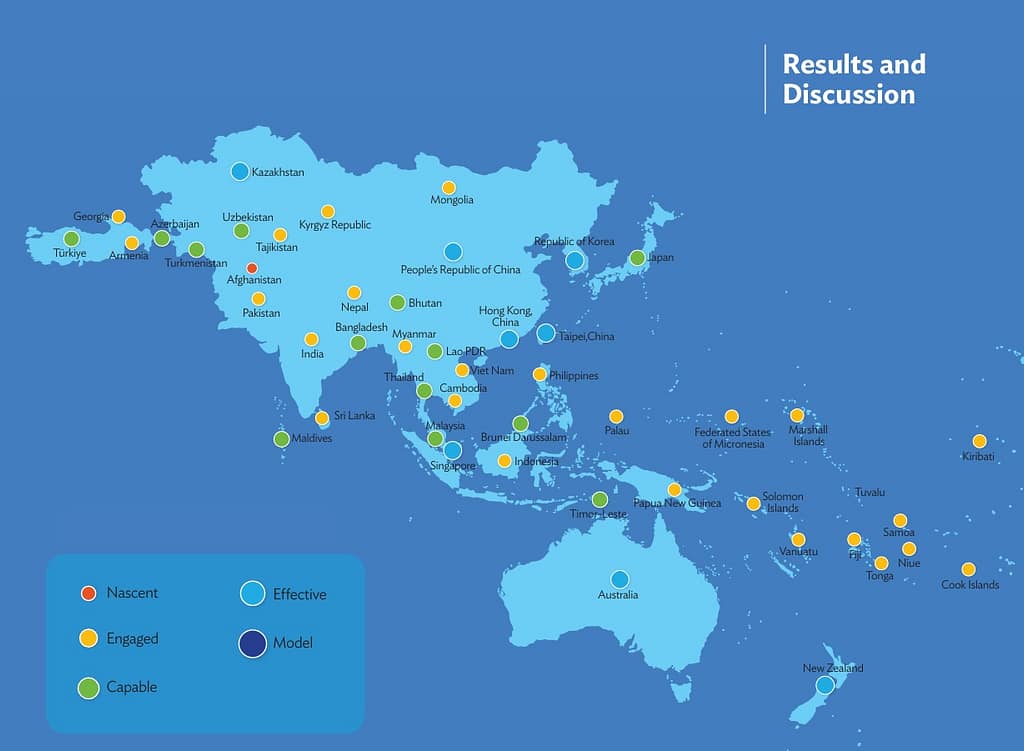
The 2025 assessment of economic water security shows that many small island developing states tend to rank in the “lower tiers of economic water security” despite being classified as upper middle-income countries. These island states are limited by structural challenges such as small economies of scale, high dependence on imports and gaps in data for critical sectors. These findings highlight the need to refine the assessment framework further to better represent the unique hydrological and economic realities of island nations.
Across the region, agriculture saw the most significant gains, driven by improved water productivity and food self-sufficiency.
One key takeaway is that water abundance does not guarantee water security. Some of the most water-abundant countries, like Sri Lanka, underperform due to infrastructure gaps and governance fragmentation. Conversely, arid nations in Central Asia demonstrate that adequate storage, improved allocation and cross-sector efficiency can offset some of the climatic disadvantages affecting economic water security. The new indicator on per capita water infrastructure investment further highlights disparities. Countries that consistently invest in water-smart infrastructure tend to outperform those that do not — regardless of geography. For example, Lao PDR saw the largest increase in scores between the previous and current ADWO, driven largely by the gains in the energy sector due to the operationalization of hydropower projects.
Strategic investment priorities for action
The outlook makes clear that economic water security does not depend on how much water a country has, but how effectively water is managed and governed, to support long-term sustainable growth.
The AWDO outlines critical strategic areas to strengthen economic water security and recommends that countries:
- Embed the water-energy-food nexus by improving irrigation systems, promoting climate-resilient crops and scaling renewable energy for agriculture.
- Modernize water data systems by investing in national water accounts, real-time monitoring and AI-driven forecasting platforms.
- Diversify water storage by combining traditional storage infrastructure with nature-based solutions like wetlands and aquifer recharge.
- Accelerate circular water economies by promoting wastewater reuse and greywater recycling in urban and industrial sectors.
- Strengthen transboundary cooperation by building trust and resilience in shared basins through data sharing and joint planning.
- Promote inclusive water governance by ensuring women and marginalized groups benefit from water investments and decision-making.
The road ahead
With the launch of the AWDO 2025 report on December 8, 2025, the full methodology, results and underlying datasets of all the key dimensions are available to the public.
These will enable governments, researchers and other stakeholders to adapt the ADWO methodological framework for their own planning and investment processes through granular assessments of different water security dimensions at the national or sub-national scale.
As the region navigates evolving water challenges, IWMI and its partners remain committed to supporting countries across Asia and the Pacific in identifying data-driven, inclusive and resilient pathways to achieve water security for all.