

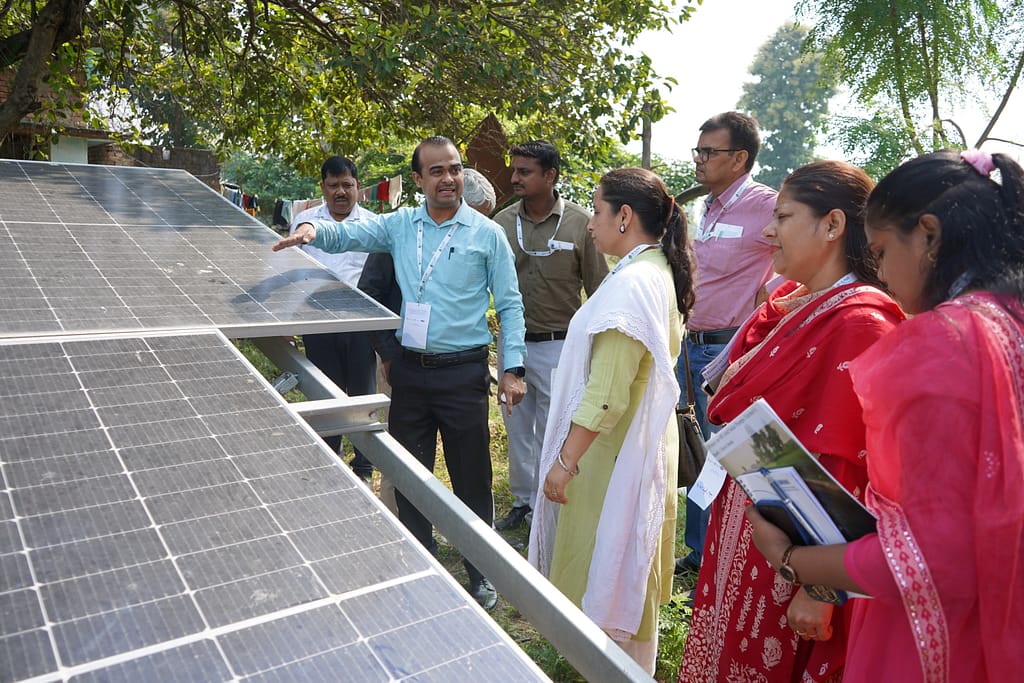
Across India’s farmlands, irrigation is emerging as a key driver of agricultural resilience in a changing climate. Today, irrigation supports more than half of the country’s cultivated land and is powered by nearly 32 million pumps, closely linking agriculture with rising energy use and emissions. Estimates suggest that groundwater irrigation alone accounts for nearly a tenth of India’s total carbon emissions, highlighting the environmental cost of groundwater extraction and the pressing need to transform how farms are powered.
In this context, solar irrigation pumps (SIPs) offer a promising path forward. As they help to reduce emissions, lower irrigation costs and improve the reliability of water access, SIPs align closely with India’s clean energy and agricultural resilience goals.
A significantly higher number of SIPs has been installed thanks to publicly funded subsidy programs, most notably the Pradhan Mantri Kisan Urja Suraksha Evam Utthaan Mahabhiyan (PM-KUSUM) scheme, which was established to de-carbonize farming. Since PM-KUSUM was introduced, over two million farmers have adopted solar energy for irrigation.
Despite rising numbers, solar remains out of reach for many farmers due to limited access to credit and reliable information. A baseline survey conducted between December 2024 and February 2025 by the International Water Management Institute (IWMI) across 24 districts in Uttar Pradesh suggests that adoption of PM-KUSUM remains slower than policy ambitions. Smallholders and marginalised farmers faced the steepest hurdles, often due to weak last-mile support, low awareness of scheme provisions and opaque procedures around eligibility and costs.
In response, IWMI turned to India’s frontline agricultural extension network, the Krishi Vigyan Kendras (KVKs), to pilot the idea of Energy Extension Agents to build awareness and trust in solar irrigation. Established in the 1970s by the Indian Council of Agricultural Research (ICAR), KVKs form the backbone of India’s agricultural extension system — a nationwide farm advisory network that provides farmers with training, technical guidance and information on new practices and technologies.
For many farmers, they are the first port of call for technical advice and training. The extension officers act as the connective tissue between policy design and field-level practice, guiding farmers along the agri-tech adoption continuum, from understanding a technology to navigating documentation and financing. The approach builds on existing institutions to accelerate adoption.
Deepak Varshney, regional researcher at IWMI, describes solar irrigation as a “climate-smart solution that boosts farm incomes, conserves groundwater and advances India’s net-zero goals.” Speaking of energy-focused extension services for farmers, he explained, “technology adoption is a social process shaped by institutions, market coordination and energy justice, where grassroots institutions like KVKs play a critical role.”
A new bridge between farmers and clean energy
Expanding the adoption of solar irrigation requires more than technology or subsidies; it depends on local mechanisms that can support farmers in understanding, accessing and effectively using new energy systems.
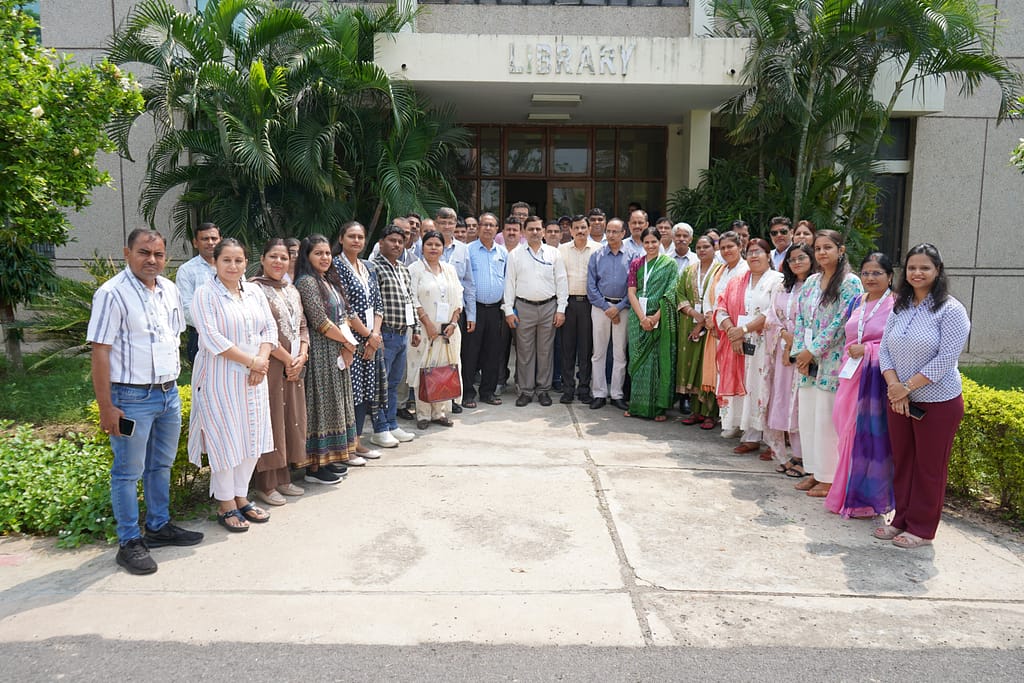
To operationalize this, IWMI is training KVK extension agents on the practical aspects of solar irrigation pumps and government schemes such as PM-KUSUM. Under the Solar Energy for Agricultural Resilience (SoLAR) project, supported by the Swiss Agency for Development and Cooperation, IWMI piloted this training program in Uttar Pradesh. The pilot sought to generate evidence on how solar energy-focused extension services can influence both demand for and adoption of SIPs.
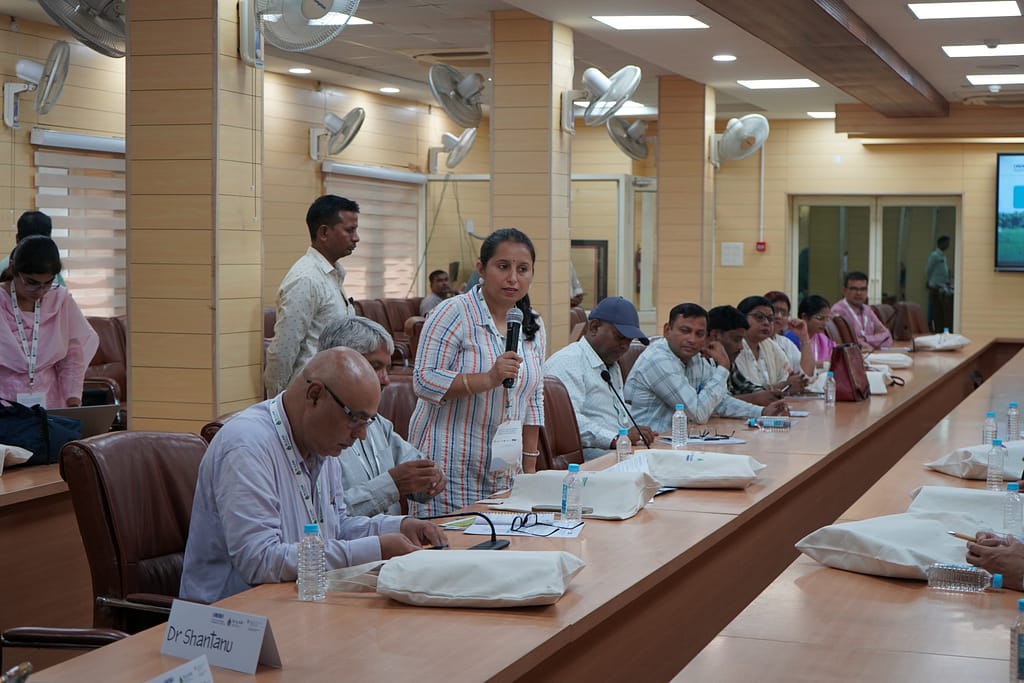
During a workshop 30 agricultural extension officers, also known as KVK scientists, from 24 districts in Uttar Pradesh were trained to operate and maintain the solar irrigation pumps. They received orientation on the PM-KUSUM scheme, including both off-grid and grid-connected solar irrigation systems. Practical guidance was provided on how to help farmers access the scheme, such as how to apply, where to apply and how the systems work, with particular attention given to reaching women and farmers from underserved communities. During field visits, officers gained practical experience in both the technical and social dimensions of solar irrigation. The training positioned these KVK scientists to assume an expanded role as energy advisors, effectively transitioning into Energy Extension Agents.
“The training was highly practical. It gave extension officers the knowledge and skills to raise awareness about solar energy and guide farmers in accessing PM-KUSUM. By equipping officers with data and evidence on energy use, water savings and income gains, the training gave them the information to demonstrate the real benefits of solar irrigation,” said Rupan Raghunvanshi, agricultural extension scientist, from Barabanki District, Uttar Pradesh, India.
Toward a resilient energy future
A recent IWMI study finds that extension support raises the likelihood of solar pump adoption by about 14 percentage points, translating to about 140 more farmers out of every 1,000 adopting the technology for the first time. Because learning spreads through spillover effects, projections suggest that a single KVK worker can engage one primary beneficiary directly while indirectly reaching up to 10 additional farmers through structured demonstrations and peer-to-peer knowledge diffusion.
Extension officers said that hands-on guidance matters. Many of the problems farmers encounter, such as misplaced panels, poor cleaning or minor technical settings, were easily fixed with basic advice and timely support. When farmers understand how their pumps work and how to maintain them, the systems operate better and confidence grows, noted Jaspal Singh, a KVK scientist.
KVK extension officers also reported that involving women in outreach and management tended to improve delivery and widen the spread of benefits.
As the pilot progresses, it is becoming clear how institutional support shapes how farmers engage with solar irrigation. Interest in the market is evident, but adoption still faces procedural and structural frictions. Uptake appears strongest when the extension system acts as an active intermediary in the energy transition, rather than when renewable energy is introduced as a stand-alone intervention.
Whether this model can travel across states and beyond remains to be seen. Particularly as policymakers seek cleaner, more inclusive rural energy systems. As field implementation continues, tracking adoption and farmer experiences will generate evidence on what drives sustained uptake and how the model can be refined for wider scale.
Darshini Ravindranath, project lead of SoLAR and senior researcher at IWMI, said that solar irrigation has the potential to transform smallholder farming in India, but its success depends on local capacity and awareness. “India’s clean energy transition in agriculture will depend not only on new technologies, but on the institutions that help farmers access and use them. Strengthening trusted advisory systems can ensure that the benefits of solar irrigation reach women, smallholders and other farmers who are often left out of such transitions.”


