

Antimicrobial resistance (AMR) has emerged as a silent pandemic, posing a mounting threat to health, agriculture and environmental sustainability. Global projections warn that by 2050, AMR could claim 10 million lives annually, surpassing cancer-related deaths. The World Health Organization (WHO) has identified AMR as one of the top 10 global public health threats.
Water is not just a carrier — it is a storehouse and amplifier of AMR. Rivers, lakes, groundwater and wastewater streams often accumulate antibiotic residues, resistant pathogens and resistance genes from hospitals, households, industries and farms.
Waterborne AMR refers to resistant microbes — including bacteria, viruses, protozoa and other pathogens — that spread through contaminated water systems. When these organisms circulate unchecked, they contribute to infections that become increasingly difficult to treat. While AMR is a global concern, the crisis is unfolding at a much faster pace in low- and middle-income countries, where unregulated antibiotic use, inadequate wastewater treatment, and limited access to safe water and sanitation create the perfect conditions for the rise and spread of drug-resistant pathogens.
India’s growing waterborne AMR burden

India faces one of the highest risks of waterborne antimicrobial resistance globally. AMR is already recognized as a national priority by the Ministry of Health and Family Welfare. According to an Institute for Health Metrics and Evaluation (IHME) report, the country ranks 60th in age-standardized mortality associated with AMR among 204 countries, and projections estimate 0.9-1.4 million AMR-related deaths annually by 2030.
Several alarming indicators highlight the scope of the challenge. Major rivers, including the Yamuna, Ganga and Cauvery, show elevated levels of resistant bacteria. For example, in the state of Bihar — where the Ganga is a vital watercourse — sulfonamide resistance genes have been detected in deep groundwater (>100 m), largely due to wastewater containing hospital and domestic waste. Nearly 80% of India’s river length is classified as having high to very high environmental risk from antibiotic pollution, affecting more than 315 million people. Further deepening the issue, the use of contaminated river water for irrigation can introduce resistant bacteria or antibiotic residues into food crops, posing additional risks to public health.
Major drivers of waterborne AMR in India
Several major drivers contribute to the rapid spread of waterborne AMR in India. The country treats only 28% of its urban wastewater, leaving the remaining 72% to flow untreated into rivers and lakes, carrying antibiotic residues, resistant microbes and resistance genes into natural water bodies.

India, along with China, accounts for nearly 80% of global antibiotic production. Although per capita consumption in India is relatively low, the widespread use of broad-spectrum antibiotics — exceeding the 5,071 million defined daily doses — intensifies the problem. Additionally, antibiotics used for disease control and growth promotion in livestock, poultry and aquaculture frequently enter the environment through manure, agricultural runoff or untreated effluents. Together, these factors create a self-reinforcing cycle that accelerates the evolution and spread of resistant pathogens across ecosystems.
Why a One Health approach is essential for India
AMR cannot be addressed by the health sector alone; it is a multi-sectoral challenge that impacts humans, animals and the environment. India must strengthen coordination across water management, public health, agriculture, animal husbandry and environmental protection to achieve meaningful progress. A collaborative response is crucial to prevent contamination of water sources, enhance surveillance across environmental and agricultural systems, improve wastewater treatment capacities, promote rational antibiotic use and reduce health risks from exposure to resistant pathogens.

International Water Management Institute (IWMI) research highlights water as a critical yet often overlooked environmental pathway in the AMR cycle. In this context, IWMI has developed a framework for waterborne AMR modelling and assessed AMR in the Song watershed together with the Indian Institute of Technology Roorkee (IIT Roorkee). More recently, IWMI published a comprehensive report on waterborne antimicrobial resistance in India. The report identifies major barriers in AMR management, gaps in surveillance, technology and institutional coordination, while recommending strategies to strengthen responses at both national and watershed levels through a One Health approach.
Collaborative action from Uttarakhand
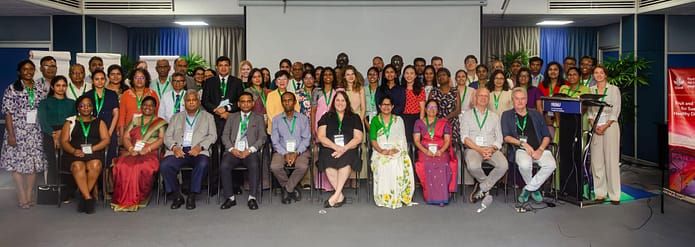
To advance this effort, IWMI and IIT-Roorkee jointly organized a national workshop on “Water Pollution and Antimicrobial Resistance” in the Song River Basin in the state of Uttarakhand on November 13-14.
The workshop brought together key government agencies and technical institutions from Uttarakhand, including the Pollution Control Board, Department of Irrigation, municipal councils, Department of Agriculture, Department of Animal Husbandry, Department of Medical Health & Family Welfare and the National Institute of Hydrology — along with NGOs such as BAIF Development Research Foundation, the People’s Science Institute and international organizations such as the World Health Organization.
All stakeholders expressed strong willingness to integrate AMR into future departmental action plans. Together, they proposed basin-scale strategies to mitigate AMR risks in the Song River Basin.
“Addressing waterborne AMR requires breaking silos,” said IWMI Country Representative for India, Alok Sikka. “Water must be recognized as a central connector across human, animal and environmental health. Only then can we mount an effective and sustainable response.”
This year’s World Antimicrobial Awareness Week, from November 18-24 amplified urgent calls for more responsible antibiotic use. In many ways, India stands at a pivotal moment. With rapid urbanization, rising water demand and growing pressure on natural ecosystems, the spread of waterborne AMR poses a serious threat to public health, livelihoods and sustainable development. IWMI remains committed to working with national partners, state governments, research institutions and communities to strengthen AMR monitoring in water systems, support wastewater treatment innovations, improve policy coherence and build capacity for integrated One Health action to support planning for water pollution control and AMR mitigation
Waterborne antimicrobial resistance in India: strategies to address the key challenges and gaps through a One Health approach