

To solve Southern Africa’s food, land and water inequalities, we must first listen to local communities and address the conflicts that divide them. Solutions must include cooperation across different actors, meaningful input from indigenous communities and effective governance.
These themes emerged at a panel discussion during the annual Science Forum South Africa held on November 24, 2025, in Pretoria. The panel, convened by the International Water Management Institute (IWMI) and the Alliance of Bioversity International and the International Centre for Tropical Agriculture (CIAT), explored the potential for just transition and peace in managing Southern Africa’s food, land and water systems.
Communities across the region are already competing for very limited water resources. Climate pressures are altering habitats, forcing communities into risky human-wildlife interfaces. This drives displacement and insecurity, deepening poverty and fueling conflict. A World Wildlife Organization analysis of over 3,000 community interviews found that 25% of respondents linked climate change to rising human-wildlife conflict, and 36% reported an increase in crop damage from wildlife searching for food.
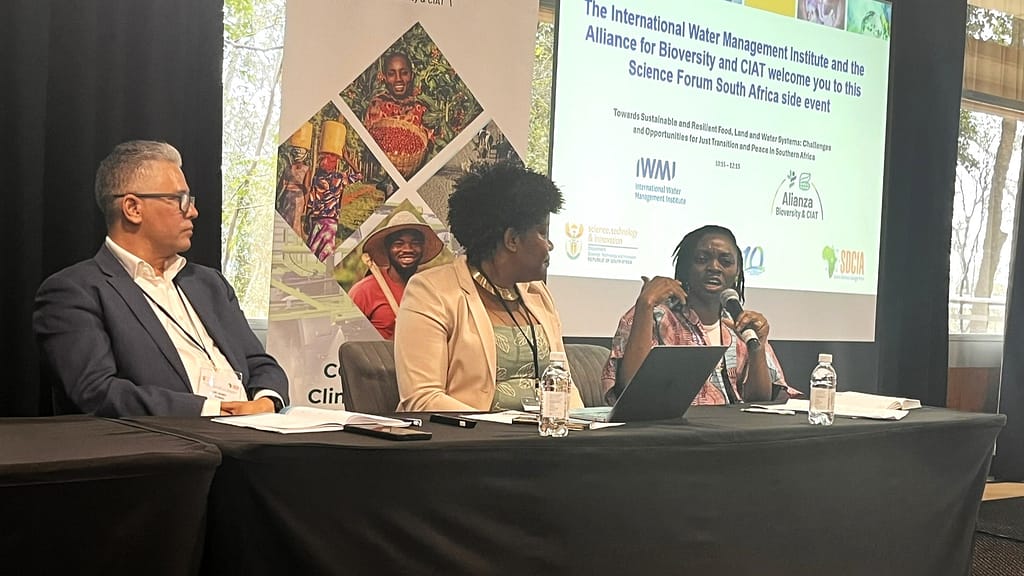
“Structural inequalities are perpetuated when systems work independently”, said Ojongetakah Enokenwa Baa, researcher on gender, social inclusion and youth at IWMI, highlighting the importance of intersectional approaches that connect climate, land, livelihoods and governance.
Adapting to climate change requires both resilience and addressing the social frictions that arise when resources become scarce due to climate change. This calls for integrated land-use planning that balances ecological needs with human safety and dignity.
IWMI’s research shows that meeting poverty-reduction goals requires balancing water and energy needs through a water-energy-food-environment (WEFE) nexus approach. This means planning that jointly considers water, energy and food systems, to help identify options that can support both energy access and sustainable livelihoods, while reducing trade-offs that harm communities and ecosystems.
Indigenous knowledge can inform scientific approaches and shape adaptation decisions, yet top-down planning and siloed approaches often exclude indigenous communities from decision-making processes. Nowhere is this more apparent than in rural communities, where calls for decarbonisation can feel disconnected from daily realities. For communities struggling with energy poverty, lacking reliable or affordable access to electricity or clean cooking fuels, climate solutions must first address immediate needs before longer-term transitions can take hold.
Indigenous communities also have generations of experience managing scarce water and land — knowledge that can help prevent the conflicts that modern policies often miss. In a just transition approach, indigenous knowledge systems are integrated with scientific knowledge to support the practical application of climate solutions in resource-scarce landscapes such as Southern Africa.
The Science Forum conversation further explored what it means to ensure equity in post-disaster responses, which often prioritizes rebuilding infrastructure over supporting displaced communities. These oversights can inadvertently redistribute vulnerability. Climate frameworks must be gender responsive, where a just transition is a moral imperative rather than a technical one.
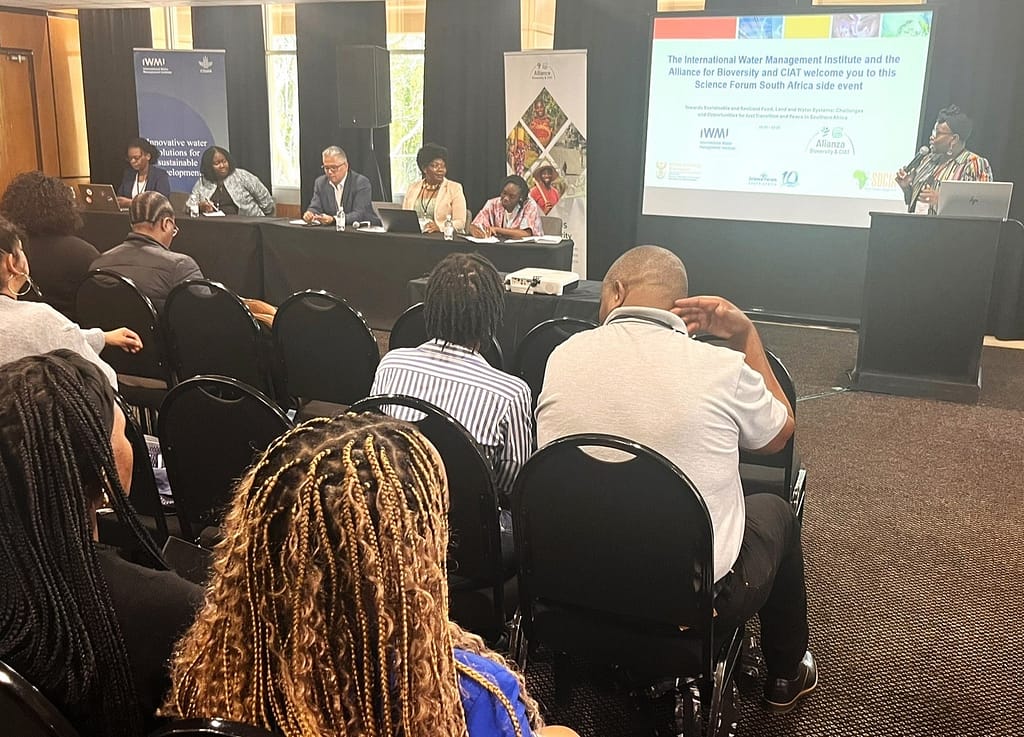
“At IWMI, we promote integrated systems thinking, inclusive governance, and the utilisation of science and innovation to scale interventions,” said IWMI’s Regional Representative for Southern Africa, Henry Roman. “By working with governments, non-government organizations, research institutes and small businesses, we avoid the pitfalls of implementing isolated interventions.”
While exploring changes needed to protect vulnerable communities and prevent conflict, participating researchers highlighted that climate action must actively include marginalised groups and avoid policies that spark new tensions.
In Southern Africa, climate change is not a distant threat but a lived reality. Peace in Southern Africa’s climate resilience will not come from political agreements alone, but from how well communities manage land, water and ecosystems that are under stress.
Southern Africa’s food, land and water systems can only become sustainable and resilient through people-centred, integrated approaches that break down silos, elevate the voices of indigenous communities and ensure inclusive governance. “A just transition must be built with communities and not for them. Peace is an outcome of just and inclusive systems,” highlighted Decide Mabumbo, senior researcher on climate risk management and disaster resilience at IWMI.
Giulia Caroli is a climate, peace and security specialist at the Alliance of Bioversity International and CIAT where she conducts research and policy advocacy work in fragile and conflict-affected countries. Reyhana Mahomed is a knowledge management and communications coordinator at IWMI’s Southern Africa office.


