
How can intergovernmental conferences better integrate water-climate issues? How will climate change impact rice farmers in western Sri Lanka? Researchers from the International Water Management Institute (IWMI) address these questions and more in publications from November and December 2025. Read on to discover open-access articles tackling the challenges facing water governance and agricultural systems today.
Black soldier fly: environmental engineer for sustainable agri-food systems
With global population growth comes increased demand for meat, dairy and fish. These industries require immense feed supplies, mostly soybeans and fishmeal, which are unsustainable when produced in mass quantities. Solomie Gebrezgahber, a researcher at IWMI, discusses an emerging alternative: black soldier flies (BSF). BSF consume organic waste and are protein-rich, making them affordable to breed and suitable feed for poultry, fish and pigs. An IWMI community project and accompanying study examines how this circular solution can turn waste into profit for BSF farmers and make agri-food systems more sustainable.
Read the full article:
Black soldier fly: environmental engineer for sustainable agri-food systems
Pathways for accountability in intergovernmental water-climate conferences
Though water and climate are intrinsically connected, they are not often enough integrated into intergovernmental conferences. Even when participants convene on water-climate nexus issues, an absence of follow-up mechanisms to track progress leaves little room for accountability. IWMI researcher Inga Jacobs-Mata, alongside colleagues, makes three recommendations for increased accountability. First, cross-sectoral indicators should be used to monitor progress on outcomes from multilateral conferences. Secondly, preparatory meetings should be held regionally prior to conferences to coordinate water-climate strategies and combat water governance fragmentation. Finally, conferences should feature more technical experts and accessible communication to promote trust in institutions and counter misinformation. Efforts in these actions will help deepen accountability and follow-through on water-climate commitments.
Read the full article:
Pathways for accountability in intergovernmental water-climate conferences
Socio-economic valuation of water reallocation: framework development and application in South Africa
Water scarcity and growing demand are pushing countries to rethink how water is shared, ensuring it supports economic development while promoting fairness. A recent study by IWMI’s Giulia Zane, Marie-Charlotte Buisson, Barbara van Koppen and Everisto Mapedza introduces a socio-economic valuation framework that helps guide water reallocation with equity, efficiency and sustainability at its core. Designed for contexts shaped by scarcity and historical inequality, the framework accounts not only for direct economic returns but also broader social benefits such as poverty reduction, food security and improved livelihoods across different user groups. Applying this approach to South Africa’s Inkomati-Usuthu Water Management Area, the authors show how it supports the country’s National Water Resource Strategy and compulsory licensing under the National Water Act. The findings suggest that reallocating water from large-scale commercial agriculture to historically disadvantaged smallholder farmers could deliver meaningful welfare gains.
Read the full article:
Gendered exclusion in agricultural water governance: A case study in district Okara, Pakistan
Gender disparities in agricultural water management remain widespread, yet Pakistan-specific insights have been scarce. New research by IWMI’s Kanwal Waqar and Mohsin Hafeez highlights a gap between women’s substantial labor contributions and their limited influence on farm decision-making. While women contribute three to four hours of agricultural labor a day, only 3% are involved in farm management decisions. National and provincial policies, including the National Water Policy 2018, Punjab Water Act 2019 and Khyber Pakhtunkhwa Water Act 2020, are largely gender-blind, offering little recognition of women’s roles. Institutional barriers deepen the problem, with women in Water User Associations often participating only as “silent observers” while 92% say trainings need to be flexible to facilitate parallel responsibilities women have at home, like daily water collection. Together, policy gaps, social norms and institutional limitations continue to exclude women from water governance. The study calls for enforceable gender quotas, better awareness and literacy programs, and gender-responsive training to support more inclusive and equitable management of water resources.
Read the full article:
Gendered exclusion in agricultural water governance: A case study in district Okara, Pakistan
Suitability of paddy cultivation in the Western province of Sri Lanka under different climate change scenarios
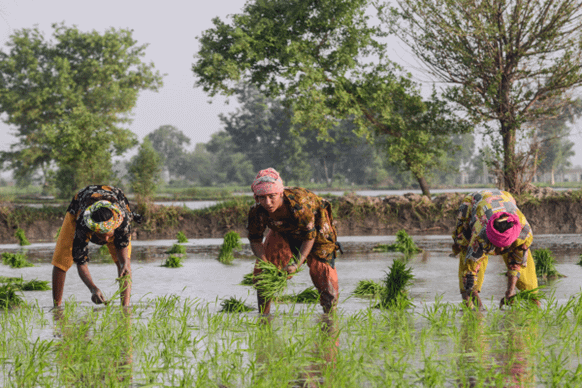
Regions in Sri Lanka’s Western Province that rely on rain-fed agriculture face climate vulnerabilities that threaten food security. IWMI’s Lal Muthuwatta and colleagues created various simulations to predict the suitability of land under different climate scenarios for paddy cultivation from 2030 and 2050. The study found that climate change will have a significant effect on paddy cultivation in the Western Province. Regions that are now highlighted as suitable will become less so due to climate change. The study recommended a comprehensive approach to climate change adaptation and mitigation in paddy cultivation planning to ensure economic and food security for the future.
Read the full article: