

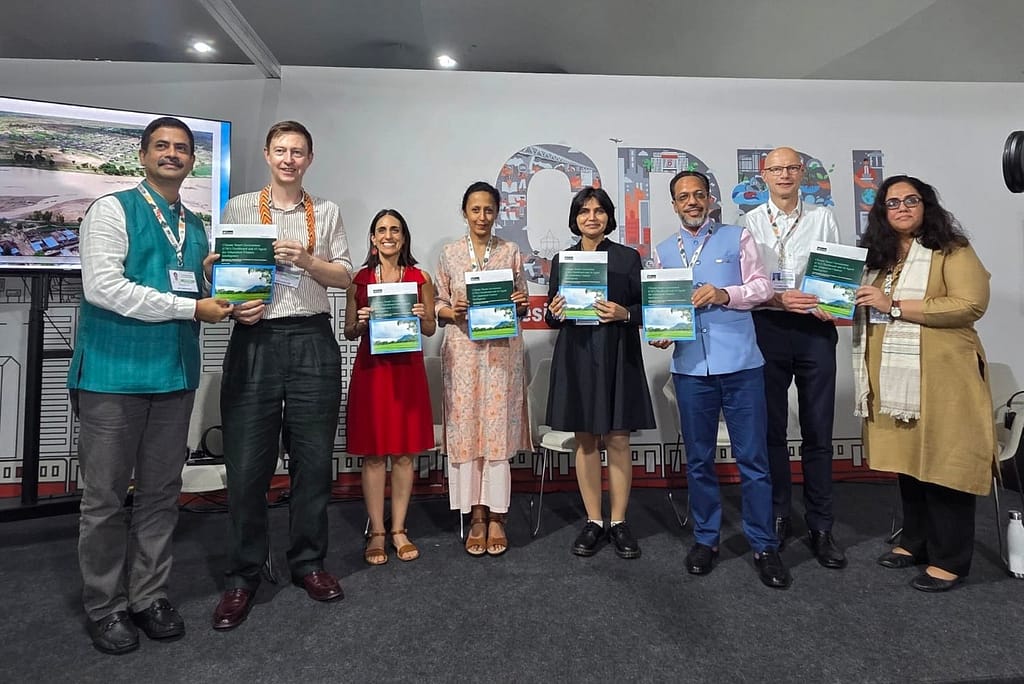
As world leaders and scientists converge in Belém, Brazil, for the 30th United Nations Climate Change Conference (COP30), the International Water Management Institute (IWMI) unveiled an artificial intelligence (AI) agent to its Climate Smart Governance (CSG) dashboard. The Climate Risk Intelligence Assistant was introduced on November 13, 2025, at the Disaster Resilient Infrastructure Pavilion, offering a glimpse into how the AI-powered tool can help countries strengthen climate governance and resilience.
“The Climate Risk Intelligence Assistant is designed to make the CSG dashboard more intuitive and practical,” said Giriraj Amarnath, research group leader for Water Data for Climate Resilience at IWMI and CGIAR Climate Action Co-Lead for Digital Advisories and Climate Risk Management. “It helps national planners connect data, science and investment by pinpointing where climate vulnerabilities lie, how much resilience still needs to be built, and which areas require greater funding.”
IWMI’s CSG dashboard helps decision-makers to plan and invest in climate adaptation. The dashboard can run cost-effectiveness analyses for climate interventions, track projects at national and local levels, and coordinate efforts across ministries and development partners. For example, Sri Lanka’s National Planning Department uses the dashboard to prioritize sub-national project investments, measure their impacts and prepare future investments in reference to climate scenarios and vulnerability. The dashboard is currently in use across Kenya, Senegal, Sri Lanka and Zambia.
The Climate Risk Intelligence Assistant
The Climate Risk Intelligence Assistant is available on the CSG dashboard interface; instead of parsing through data on the dashboard themselves, users can ask targeted questions and have the AI agent do the background work for them.
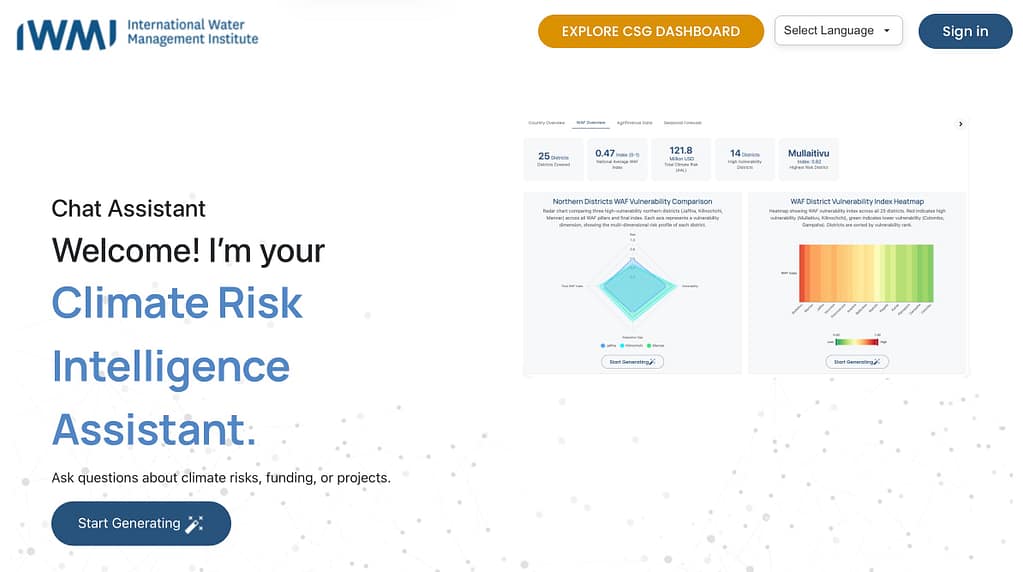
The goal of the assistant is to make abstract climate science speak the language of budget planners — showing how much exposure or loss a region might face and what level of funding is needed to close the gap. At the tool’s launch, IWMI Board Chair and Executive Director of the Global Commission on the Economics of Water, Henk Ovink, underscrored that IWMI’s AI agent “supports countries’ capacity to progress from fragmented action to investment-ready decisions.”
The AI agent uses four large language models that employ linguistic analysis to follow prompts and generate written text. The quality of the agent relies upon the quality of the data put into the system. The CSG dashboard draws from validated national datasets, models from the Coalition for Disaster Resilient Infrastructure (CDRI), climate scenario data from the World Bank, project investment data from relevant agencies, and Sustainable Development Goal indicators from the United Nations. The Climate Risk Intelligence Assistant can then process these complex climate, economic and infrastructure datasets into actionable insights for policy and finance.
The assistant can address a range of simple to advanced queries. For example, one could ask “how much has been invested in water resilience over the past five years,” or “what are the ongoing climate adaptation projects in this province?” The system then scans the nine modules within the CSG dashboard — including climate outlooks and project trackers — and provides consolidated, data-backed answers. Users can also simulate climate change scenarios, such as asking the assistant, “what is the effect of a 20% rise in drought-prone areas on infrastructure exposure and adaptation costs?”
AI in the global climate arena
AI is not technically part of formal negotiations at COP30, but it is shaping discussions in and around the table. Many see AI technologies as having the potential to spur climate action, including the architects of COP30’s Action Agenda — the platform for civil society, businesses, cities and other non-state actors. One of their key objectives for this year’s conference is “unleashing enablers and accelerators,” which includes artificial intelligence. AI has the potential to optimize energy use, predict extreme weather events or shape urban resilience planning.
Efforts are underway to finance climate AI projects: on November 11, a global initiative called the Artificial Intelligence Climate Institute was launched in Bélem to assist the Global South in leveraging AI for technical climate change solutions.
A good example of what such technology could look like is IWMI’s SukhaRakshak AI, which uses the Google Gemini AI model to help users navigate drought situations and provide timely advisory support for farmers, extension agents and drought management authorities in India. The system delivers actionable guidance in 22 native Indian languages, enabling anticipatory decisions and investments.
Excitement over such potentially groundbreaking technology is palpable, yet COP30 is also an opportunity for AI critics to voice their concerns. Despite emphasis on AI’s potential to help tackle climate change impacts, there are important concerns that need to be addressed, such as its intensive energy and water demands, which are straining the electric grid, contributing to greenhouse gas emissions and depleting clean water sources.
Leading up to COP30, the UN Climate Chief Simon Stiell voiced his hope for governments and organizations to harness AI’s potential responsibly, using it to address climate challenges rather than displacing human talent or exacerbating environmental risks.
The Climate Risk Intelligence Assistant demonstrates how technology can be applied constructively, helping national planners and policymakers design targeted, data-driven climate solutions. Post-launch, IWMI will operationalize the CSG AI agent through country pilots, integrate new data streams and finance modules, and strengthen capacity building to ensure governments can use it for real-time, decision-ready climate governance.
As Ovink emphasized at the launch, “By linking climate and hydro scenarios, cost-effectiveness and on-the-ground vulnerability with long-term anchored pathways for equitable resilient climate actions, the AI assistant helps governments plan smarter, spend better and scale resilience where it matters most.”