As climate change threatens food and water security globally, scientists increasingly look to artificial intelligence (AI) tools to help farmers face mounting agricultural challenges. In a major step towards scaling these solutions, the United Arab Emirates (UAE), in partnership with the Gates Foundation, launched an AI Ecosystem for Global Agricultural Development in December 2025. The International Water Management Institute (IWMI), as part of CGIAR’s AI Hub, is a core contributor to this ecosystem, collaborating with AI71 and developing AI-driven solutions for water resilience.
The UAE AI Ecosystem has produced four flagship efforts: the Institute for Agriculture and Artificial Intelligence (IA|AI), the CGIAR AI Hub, AgriLLM and AIM for Scale, mobilizing a network of organizations and technologies to develop agri-AI solutions.
“Bringing together AI and scientific research is no longer optional if we are going to overcome looming challenges in food systems and water security. It’s how we can close persistent data gaps, understand climate risks in real time and help countries make smarter decisions,” said IWMI’s Director General Mark Smith. “New technologies and AI can and will be gamechangers in the management of water and water risks in agriculture and food systems.”
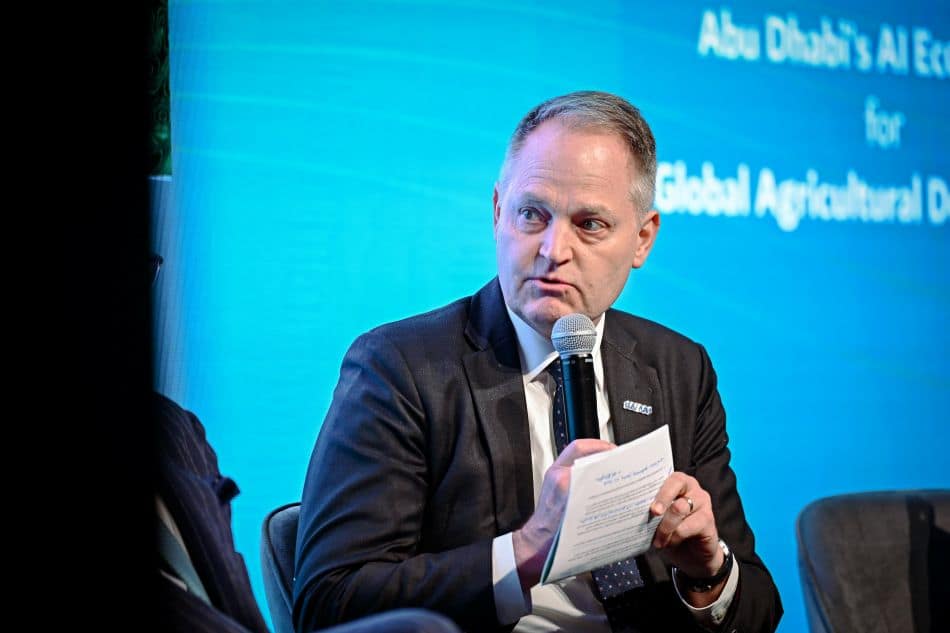
Accessible dissemination of scientific research is critical in supporting adaptation efforts and uplifting livelihoods as climate change intensifies. Advances delivered by the CGIAR AI Hub include IWMI’s Global Hydrological Foundation Model, which reimagines how hydrological forecasting systems are delivered in a way that is responsive to local realities. Drawing on insights from previous AI-driven Digital Twin for River Basin Management projects, the model invests in strengthening farmer resilience. The AI-driven framework brings together near-real-time global datasets and hydrological modelling of river basins, aiming to remove the bottleneck of manual configuration. This enables the deployment of accurate hydrological models that reflect conditions on the ground — at scale. Thereby, translating complex science into immediate, local impact, especially in data-scarce and climate-vulnerable regions.
An example of IWMI’s effort to integrate AI across projects as a tool to accelerate impact is the Limpopo Water Copilot, developed in partnership with Microsoft. The Water Copilot promotes data-driven water management through AI agents trained on extensive datasets and scientific models. It features a chatbot interface integrated with the digital twin — a virtual representation — of Southern Africa’s Limpopo River Basin. The Limpopo Water Copilot translates timely, complex, near-real-time data into accessible insights that support decisions on climate and environmental change, particularly useful for water managers and citizens.
This work is complemented by other AI-driven initiatives at IWMI, including tools for climate-smart planning and investment that help governments and development partners assess water risks, prioritize interventions and design resilient infrastructure. IWMI is also supporting the development of an AI backbone for CGIAR science, streamlining how research data, models and evidence are connected and used across disciplines. In parallel, AI enabled citizen science networks in Southern Africa are combining community-generated observations with machine learning to monitor freshwater ecosystems and strengthen early warning and response.
Together, these digital tools sit at the heart of how information is shared, requiring user-friendly platforms that make data accessible and scalable for farmers and communities across the globe. Aligned with IWMI’s vision to extend a digital hand from researcher to farmer, AI-powered agents foster collaboration among the water community, integrating historical and near real-time data to inform more inclusive, timely and effective decision-making.
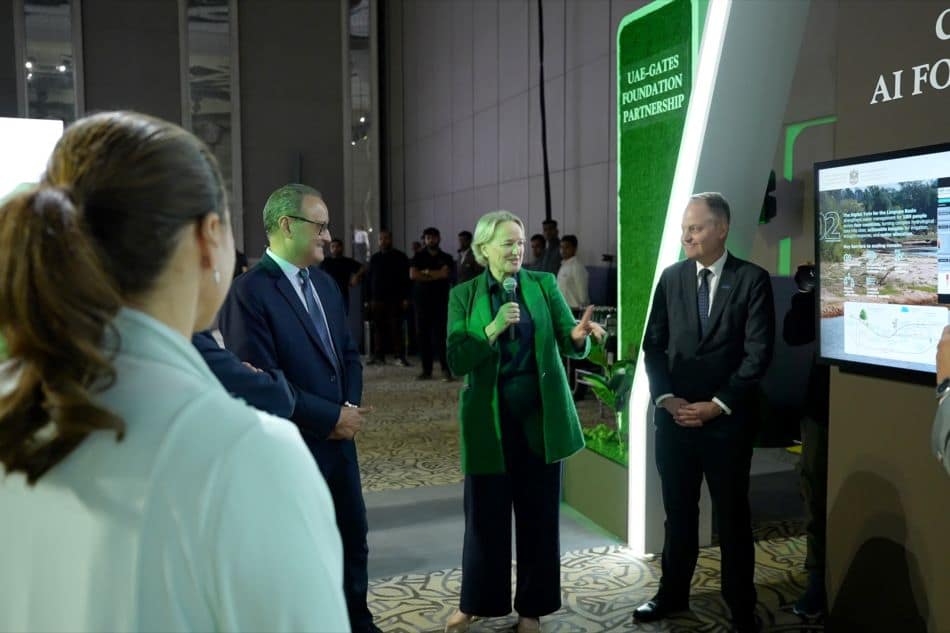
“For farmers on the frontlines of climate change, access to timely and usable information can make the difference between a good season and a failed one,” said Rachael McDonnell, deputy director general for research development at IWMI. “By using AI to translate complicated climate and water data into practical, locally relevant insights, we are helping bridge the gap between science and decision-making on the ground.”
Backed by an alliance of multi-sector partnerships, the UAE AI Ecosystem for Global Agriculture Development is harnessing artificial intelligence to turn global research into practical, climate-smart tools — helping farmers and communities adapt, plan and thrive in a world of increasingly extreme weather.