

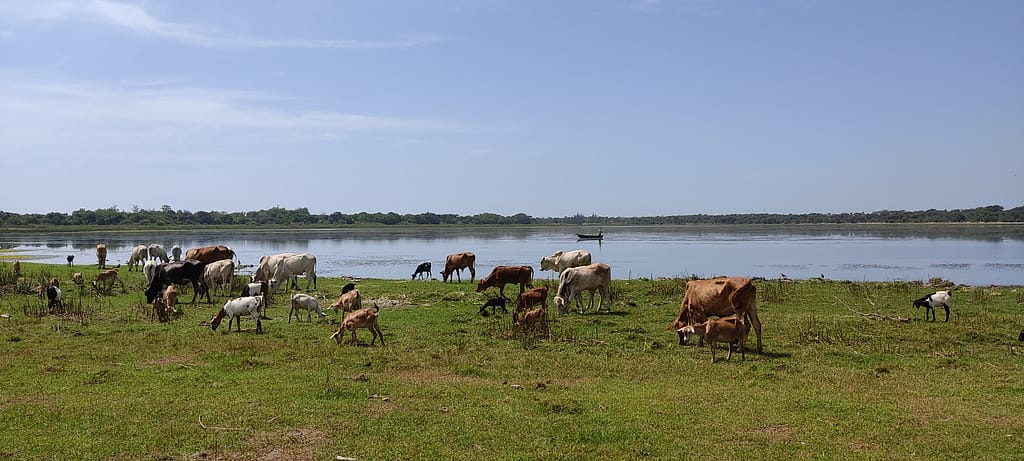
More than two billion people across the world depend directly on freshwater systems for their drinking water, food and livelihoods, including their resilience to climate change. Freshwater is water with low concentrations of dissolved salts and other solids. Freshwater ecosystems can comprise diverse habitats varying from rivers, lakes, springs, streams, reservoirs, inland wetlands and aquifers.
In principle, these freshwater systems are wetlands; they underpin human wellbeing and economic activity, while supplying water for domestic use, agriculture, sanitation and industry. Keeping these systems healthy and ensuring equitable access reduces pressure on limited water supplies.
However, the reverse is also true: when freshwater ecosystems are degraded or depleted, scarcity grows. Clean, safe water becomes harder to find, food production suffers and household incomes decline. Already, water scarcity is a leading source of tension and conflict globally. These stresses often deepen inequalities, spark disputes and raise the risk of conflict. Reliable access to freshwater helps communities meet their daily needs, build trust and lay the groundwork for long-term peace and stability.
In January, the United Nations (UN) declared a “global water bankruptcy,” describing the unsustainable depletion and degradation of Earth’s water resources as a chronic issue, not a temporary crisis.
What is the Freshwater Challenge?
In March 2023, six countries — Colombia, the Democratic Republic of Congo, Ecuador, Gabon, Mexico and Zambia — came together at the UN Water Conference to launch the Freshwater Challenge. As a global initiative, the FWC aims to restore 300,000 kilometers of rivers and 350 million hectares of wetlands by 2030. To put that in perspective, this is the equivalent of enough rivers to circle the planet seven times and wetlands covering an area larger than India, and all this to be accomplished within the next four years. Three years since its launch, more than 50 countries and the European Union have joined the program.
Participating countries define their own priorities and integrate restoration into national policies on biodiversity, climate and development. For example, by 2025, countries were expected to identify priority freshwater ecosystems, set measurable and time-bound restoration targets, and align objectives with global agreements and frameworks such as the Sustainable Development Goal 6, UN Decade of Ecosystem Restoration, Kunming-Montreal Global Biodiversity Framework and UN Framework Convention on Climate Change, among others.
Why is the Freshwater Challenge important?
The Freshwater Challenge isn’t just ambitious in size. It tackles one of the most urgent and overlooked crises of our time: wetland degradation and depletion. Freshwater ecosystems are declining faster than any other ecosystem on the planet, including forests. Global assessments show that large-bodied animal species populations dependent on freshwater have dropped by more than 80% since 1970, a clear indicator of the pressures facing rivers, lakes and other wetlands worldwide.
Further, the Global Wetland Outlook 2025 reports that 22% of the world’s wetlands have been lost since 1970, with the freshwater ecosystems decline registered as highest. Nearly a quarter of the wetlands (both inland and coastal) that remain are already degraded, and without urgent action, a further 20% could disappear by 2050.
The consequences of this loss are far-reaching. Wetlands provide enormous economic value, estimated at US$39 trillion annually, through services such as water purification, flood protection, food production and carbon storage. As these ecosystems deteriorate, so do the benefits they provide to communities and economies. The main drivers of this decline include dams and diversions, over-extraction of water, pollution, invasive species, and expanding urban and agricultural land use. The FWC will accelerate countries’ efforts at restoration and conservation and bring additional investment, hopefully slowing or reversing the decline of freshwater systems.
Past efforts to curb loss and decline of wetlands have often been fragmented and underfunded. The Freshwater Challenge seeks to change the track record by uniting countries around coordinated and supported action. Its goal is to reshape how countries value, finance and manage their freshwater resources at a national level. The initiative urges governments to treat rivers, lakes and wetlands as essential national assets that are central to security, development and resilience. It brings governments, communities and experts together to map degraded waterways, restore natural flows and strengthen the institutions that govern water resources.
What roadblocks has the Freshwater Challenge faced?
The Freshwater Challenge has helped generate global momentum and supported the development of national commitments and policy frameworks. Several obstacles, however, continue to slow its progress.
A major barrier is the lack of reliable, up-to-date data on the health of freshwater systems. Without such baselines, countries struggle to identify priority areas, track impacts or make compelling cases for investment. Fragmented institutional mandates add another layer of difficulty. Ministries of water, agriculture, environment and finance often operate in silos, leading to duplication, weak coordination and delays.
Funding remains a critical gap. By December 2024, the Global Environment Facility had committed an initial US$5 million, with over US$10 million in co-financing from NGOs, private sector and member countries. Yet the Global Wetland Outlook 2025 estimates that reversing wetland loss will require US$275–550 billion every year. Many governments and local authorities lack the stable, long-term funding needed for planning, restoration, monitoring and community engagement.
Capacity constraints also limit progress. Communities are often missing the resources and technical skills to design, implement and sustain restoration efforts. Further, the needs of freshwater ecosystems are often undervalued and overlooked by competing land uses such as agriculture, mining, infrastructure development, fisheries, urbanization and energy. Inadequate enforcement of environmental regulations for such projects enables degradation.
Transboundary waters face additional complexities. Differing governance systems and political sensitivities can hinder joint planning, data sharing and cross-border cooperation for shared rivers. Increasing climate extremes such as prolonged, frequent droughts and destructive floods — which happen across borders — intensify the urgency of restoration and make it harder and more costly to achieve.
What is the road ahead for the Freshwater Challenge?
The need of the hour is implementation. With clear national targets, effective conservation measures and stronger partnerships, countries can turn plans into measurable results. Development organizations and multilateral institutions can support this shift by helping link national and transboundary efforts to a wider range of financing sources, including private sector and blended finance, to scale restoration and safeguard vital freshwater ecosystems.
Meeting the Freshwater Challenge requires all stakeholders, including the public, to act collectively. That means strengthening political commitment, establishing quantitative indicators and targets, guiding decisions through more representative data, scaling nature-based solutions and establishing robust monitoring frameworks to systematically assess progress.
The Freshwater Challenge also calls for bringing communities into decision-making and implementation. Steps that, if taken together, could turn its ambition into large-scale, sustainable freshwater restoration.
The path forward is complex, but achievable.