

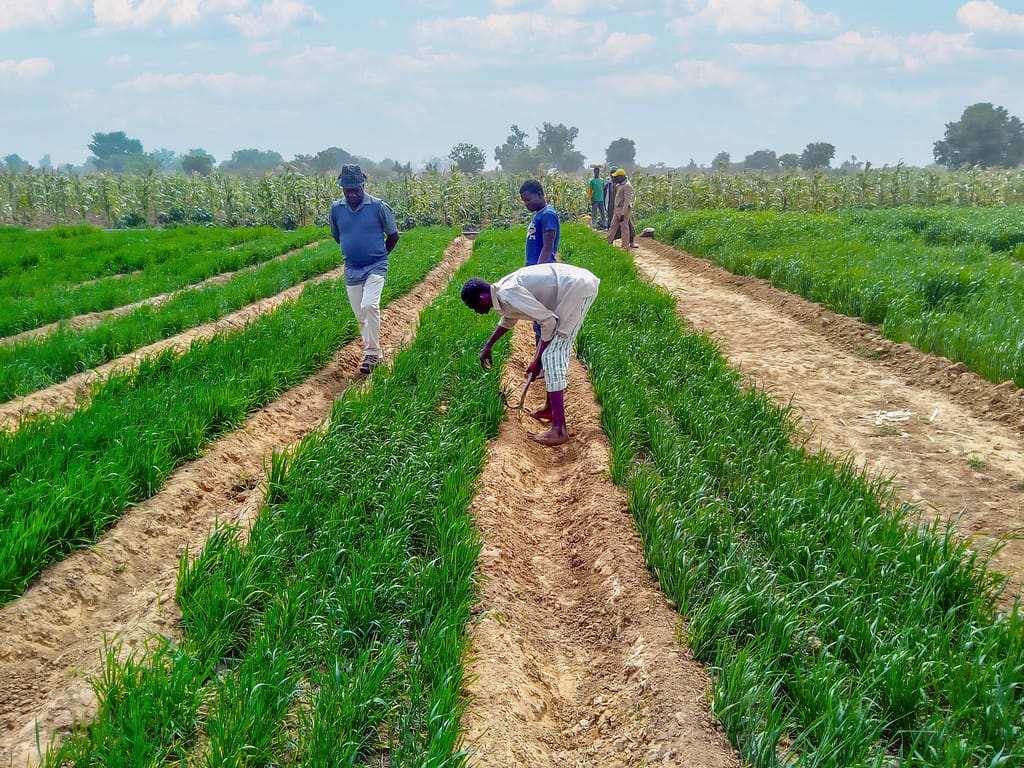
Nigeria is currently experiencing a food security crisis with 30.6 million people facing acute hunger due to conflict, rising inflation and the escalating impacts of climate change. More intense and frequent floods and droughts have adversely impacted the country’s agricultural sector, damaging yields and increasing the vulnerability of local communities.
In this context, irrigation is a critical adaptation and resilience-building strategy.
An estimated 14.5 million smallholder farmers who produce about 90% of the nation’s food are heavily reliant on rainfall. Three million hectares of Nigeria’s agricultural land have the potential to be irrigated, but only about 5% is currently being irrigated, according to data from the Federal Ministry of Water Resources. This is a clear signal that the country’s irrigation potential is vast, yet remains untapped. This is due to high costs related to equipment, operation and maintenance, farmers’ lack of knowledge and training, poor infrastructure, limited access to credit, and weak government support and policies, all of which are hindering the adoption of even small-scale systems.
Irrigation provides access to water throughout the year, improves water productivity and helps build the resilience of agrifood systems. Nigeria’s Federal Government has demonstrated a renewed interest in promoting irrigation as a key strategy to increase year-round agricultural productivity.
Existing interventions, however, generally focus on formal, developed irrigation schemes, while informal, farmer-led approaches receive less attention despite their potential to ensure efficacy, sustainability and adaptation to irrigation solutions.
A farmer-first approach
Farmer-led irrigation development (FLID) is a concept that enables farmers to invest in affordable irrigation solutions, increases access to year-round irrigated food production, fosters rural entrepreneurship and drives innovation. FLID differs from formal irrigation schemes, which are driven by large-scale investment.
Farmer-driven and flexible, FLID helps farmers decide which crop to cultivate, irrigation method to use, technology to scale and market to explore. For instance, in Kano, Kaduna, Kebbi and Sokoto shallow groundwater tube wells have helped facilitate year-round crop production and increased food security.
Supporting farmer-led irrigation development can boost Nigeria’s food security and therefore warrants urgent action. However, adoption is constrained by weak cross-sectoral coordination, policy incoherence, lack of flexible financing, misalignment of national needs and priorities with development interventions. To benefit from the full potential of FLID and accelerate irrigation innovation uptake, markets need investment, an enabling environment and better coordination between different agricultural programs.
As small-scale irrigation innovations and technologies like FLID become more accessible and affordable, scaling up farmer-led irrigation development becomes a potential solution for reducing smallholders’ reliance on rainfed systems.
A multi-stakeholder platform on farmer-led irrigation as a catalyst for change
Scaling up FLID requires collaboration and coordinated action. The International Water Management Institute (IWMI) has established a multi-stakeholder platform on farmer-led irrigation to do just this. The platform brings together diverse stakeholders across Nigeria’s irrigation and agricultural sectors to foster cross-sectoral engagement, collaborative priority setting, demand articulation and investment to shape the country’s FLID agenda.
The platform was launched in partnership with the Federal Ministry of Water Resources and Sanitation, the Ministry of Agriculture and Food Security, the Bank of Agriculture and the World Bank-financed government of Nigeria Agro-Climatic Resilience in Semi-Arid Landscapes (ACReSAL) project.
The platform was informed by IWMI’s expertise across the West Africa region, from developing solar irrigation solutions and the Vegetable Irrigation for Climate Resilience mapping tool, to the IRRILINE advisory hotline, which helps farmers in Ghana access irrigation-related information.
Partners of the platform are hopeful that it will serve as a hub for research, innovation and strategic coordination to drive FLID in Nigeria.
A roadmap for action
Moving forward IWMI will support platform stakeholders through quarterly dialogues to track demand signals and guide future interventions to support Nigeria’s national agenda. These dialogues will discuss innovative financing mechanisms like improved access to credit to de-risk FLID investments. They will inform policy design that supports an enabling environment for investment and sustainability. The exchanges will also help in the development and promotion of market-based and technically feasible solutions such as solar-powered irrigation innovations that match the small-scale, entrepreneurial nature of Nigerian agriculture.
Strengthening the capacities of farmers will be a continued priority. Researchers will support the development and deployment of digital decision support tools. These tools will provide granular data on groundwater budgets, weather forecasting and market prices, empowering farmers and water governance institutions to use water sustainably and profitably.
The multi-stakeholder platform is timely. The government of Nigeria and the UN’s Food and Agriculture Organization (FAO) co-hosted a high-level investment forum in September to unlock opportunities in irrigation as part of FAO’s Hand-in-Hand (HiH) initiative. IWMI is going to work with the government and partners to further enhance investment opportunities in irrigation resources through stakeholder engagement and partnership-building.
By promoting small-scale irrigation and supporting smallholder farmers to improve water use, the platform will contribute to achieving Africa’s Agenda 2063, specifically in the areas focusing on prosperity and better living standards, and political and economic integration.
By putting farmers first, the platform will contribute to equipping Nigeria’s smallholders with innovations to strengthen agrifood systems, and secure sustainable livelihoods for vulnerable populations.


